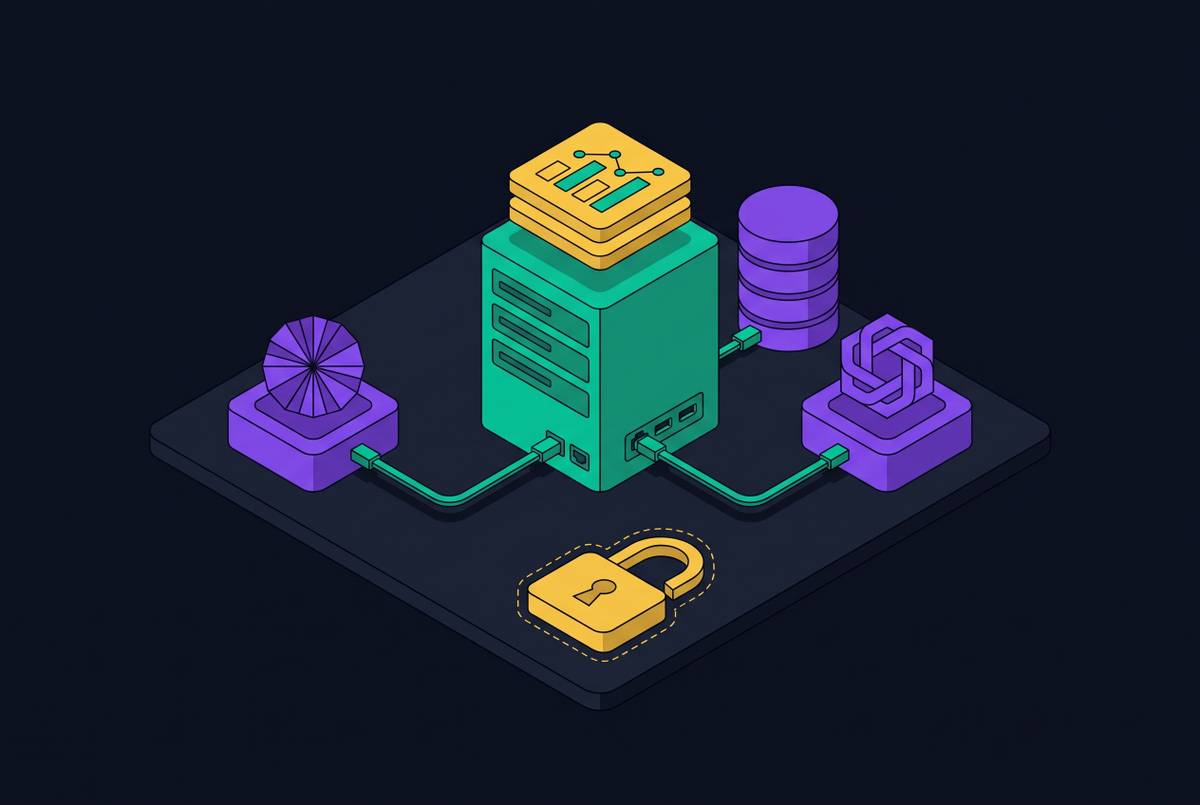
How an MCP Analytics Server Decouples Agent Query Intent From Supabase Execution
Separating query intent from execution prevents resource exhaustion and metric inconsistency.
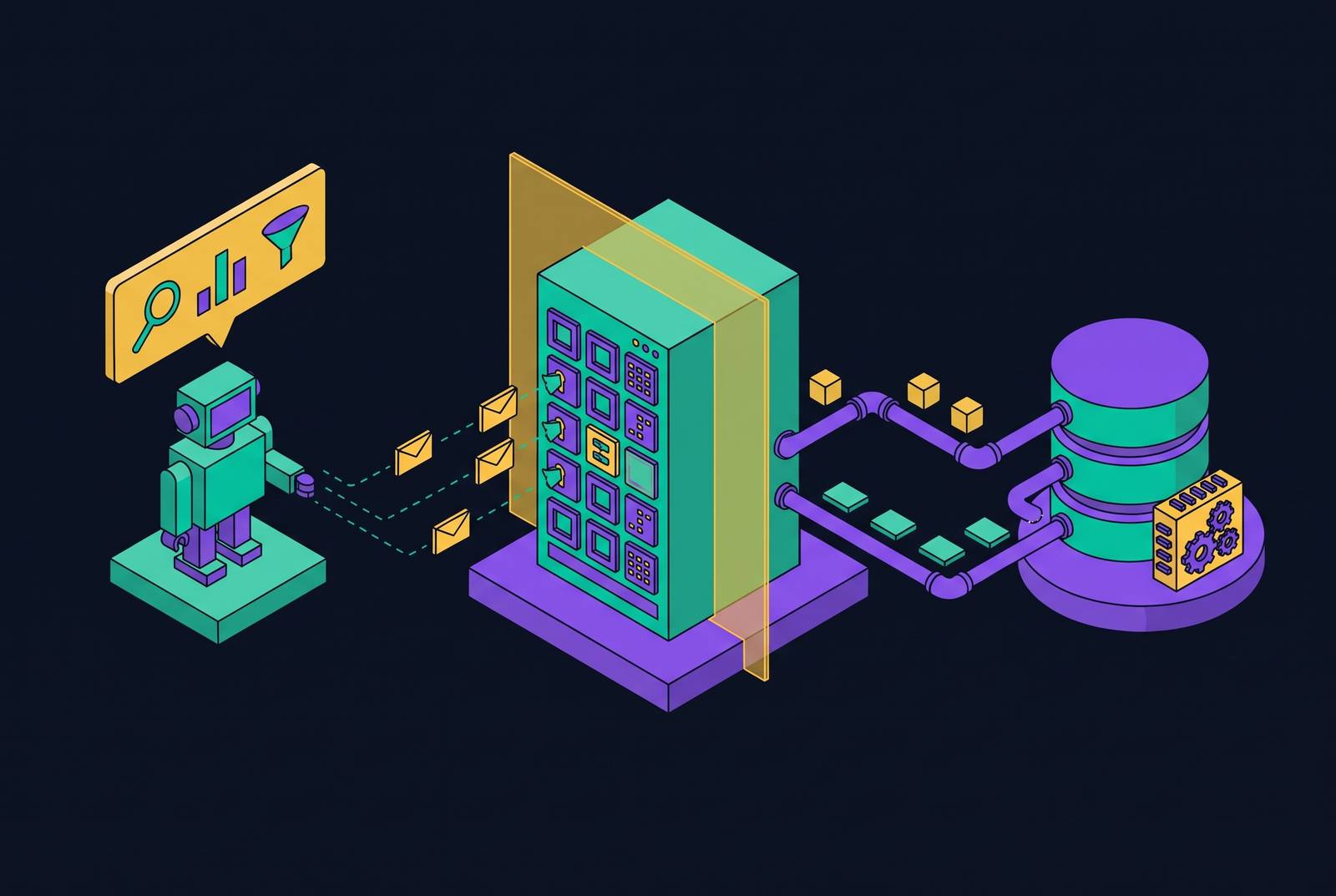
An MCP analytics server decouples agent query intent from Supabase execution by resolving questions against governed metric definitions and controlling SQL generation. The agent asks for a business result, while the server enforces its definition and access rules before compiling a query.
Why AI agents querying Supabase directly is not an analytics architecture
A read-only Postgres role does not protect Supabase’s connection pool from an agent’s queries. A call such as pg_sleep(3600) holds a connection open without changing any data. Repeated calls can use up the pool, so the production application starts returning errors to real users. Read-only is not the same as resource-safe. The permission prevents writes, but it does not contain the cost of the work the agent requests.
Analytical queries create a similar risk without deliberately holding connections open. In a documented test against a live Supabase instance, the most complex analytical query caused the overwhelming majority of concurrent read operations to fail. The database was answering an analytical question while also serving application traffic.
An LLM writing SQL against raw tables may sum the wrong column, ignore returns, or double-count records, then report the result confidently. Even engineers can produce divergent Q2 revenue figures when one uses SUM(revenue) and another uses SUM(amount_captured). The disagreement may stay hidden until an investor asks for audited figures. Giving an agent table access leaves it responsible for defining the metric as well as retrieving it.
What intent resolution means and why it is the architectural guarantee an MCP analytics server provides
Intent resolution separates what the business needs to know from the instructions sent to the database. The client, which is the AI agent, expresses intent in natural language, such as “What is monthly churn this quarter?” The MCP server looks up the governed definition of churn, enforces what the agent may ask, and compiles the query that implements that definition. The resource then executes only the compiled, validated query. That resource may be Postgres, a governed Parquet dataset, or a DuckDB layer.
These are three distinct layers with different responsibilities. The client identifies the result it needs, the server resolves and controls the request, and the resource performs the computation. The agent never needs to see a table or write SQL in this architecture. Authentication, query execution, and error handling belong at the server boundary, rather than being responsibilities the agent must improvise. The question can stay the same even when answering it calls for knowledge of the underlying data.
An agent with direct table access but no semantic context guesses, while an agent with semantic context but no query access cannot answer. An analytics server joins the two under enforceable rules. The semantic layer owns the definition. This architectural guarantee requires a governed implementation of the MCP protocol.
How the MCP specification’s stateless design makes this architecture horizontally scalable
The 2026-07-28 MCP specification revision makes stateless operation the protocol’s default, allowing the intent-resolution tier to scale horizontally like a web service. It removes protocol-level sessions and the Mcp-Session-Id header from Streamable HTTP. Tool, resource, and prompt lists no longer change from one connection to the next. The revision also removes the initialize/initialized handshake. Instead, every request includes its protocol version and client capabilities in _meta, so serving a request no longer depends on that connection’s initialization history.
This changes how the tool tier can be deployed. Any request can reach any server instance behind a round-robin load balancer without sticky routing or a shared protocol session store. That flexibility fits agent workloads, which can issue several tool calls while answering one question. A flow may retrieve metadata, obtain a metric contract, execute a query, and validate freshness before returning an answer. Across automated workflows, these calls turn the MCP layer into a substantial service tier.
The specification also exposes controls useful at that boundary. Mcp-Method and Mcp-Name headers on POST requests allow gateways to route requests and enforce per-tool budgets without parsing JSON bodies. List results include ttlMs and cacheScope caching hints, with private appropriate when a list depends on caller permissions. Servers must implement server/discover to state which versions and capabilities they support and who they are, though clients do not have to call it.
Servers that need state across calls create explicit handles and pass them as ordinary tool arguments. Identity, query jobs, and approvals must live in durable systems that keep them beyond the life of the connection. MCP standardizes the interaction between agents and tools, but it does not choose trusted tables, define metrics, or make queries fast. Those responsibilities remain with the data platform.
Why pre-governed metric definitions — not on-demand SQL — are the right unit of analytics for agents
The durable foundation of agent analytics is a pre-governed metric definition, supported by pre-calculated data, rather than a fresh SQL interpretation for every request. Without a strict data dictionary, queries against the same tables can give different numbers. The system has delegated business meaning to each query author.
Sales, finance, and product often disagree over ARR. When each function derives its own version, leadership must reconcile numbers before making decisions. Letting agents generate SQL repeats that failure at the speed of agent invocations. A governed metric sets the definition before the request comes in. The query then carries out an agreed contract without adding a new interpretation.
Data Product MCP research demonstrates the hard-constraint enforcement pattern. Schemas, semantic definitions, and rules for joins and aggregations become executable guards enforced through a SQL gateway. Queries that break policies are rejected before they run. Each interaction also creates an immutable audit chain linking what the business asked, purpose, governing policies, generated query, and results. Governance controls what runs, so the rules do not depend on an agent reading the documentation.
For Supabase teams, governed datasets also offer workload isolation. Pre-calculated metrics queried through DuckDB against governed Parquet files keep agent queries away from the production Postgres instance. Choosing an execution resource that isolates the agent’s query surface from the production connection pool is an architectural decision. The semantic contract determines the answer, while the governed dataset provides a separate place to retrieve it.
What metric governance actually requires at the definition layer, before any agent query arrives
A trustworthy definition layer starts with a data dictionary shared by dashboards and agents. For most B2B SaaS startups, the actionable starting set is small, including CAC, LTV, monthly churn, ARR, and gross margin. Each metric needs one definition and reconciliation to an authoritative source. ARR comes from billing, cash from the bank, and usage from the analytics layer. Engineers need to set up those links before conflicting answers show that they are missing.
The formula alone is not a sufficient contract. Definitions must also encode join logic, grain, and exclusion rules so that execution preserves the intended meaning. Those rules determine what counts as a return, what qualifies as an active user, and which records are excluded from ARR. The research describes this as making contracts computational objects.
Permission scoping belongs in that same definition layer. Under the 2026-07-28 revision, a tool list for a specific caller can use cacheScope set to private so that its cached contents are not shared across authorization contexts. The server must still enforce which metrics the caller may access. A private cache setting preserves that separation but does not replace authorization. For Postgres execution, row-level security is evaluated per row, so a query touching millions of rows incurs millions of evaluations. Pre-scoped metric definitions save that work when they do away with the need to generate a query that touches those rows.
Governance must also leave a reconstructable record. Every agent query that resolves a metric definition should log what the business asked, the resolved definition version, the compiled query, and the result. The version identifies which definition governed the answer. This audit output connects business meaning to execution. It also establishes the context needed to interpret the database-side signals that production monitoring exposes.
Observability requirements for a Supabase stack running agent query traffic
A governed MCP layer limits agent-generated SQL, but it does not eliminate the need to observe Supabase. When governed queries still run against Postgres, they use database resources even though their meaning is controlled. Connection pressure, query latency, and error rates must be in view before problems reach users. Those signals form the minimum production dashboard. They expose the operational consequences of connection-pool exhaustion and interference between analytical and application workloads.
Supabase’s Metrics API exposes Postgres metrics compatible with monitoring tools, covering CPU, IO, WAL, connections, and query statistics. Its OpenTelemetry integration allows logs, metrics, and traces to be exported to compatible observability tools. On paid plans, log drains offer another way to send logs to external destinations. Supabase made analytics through Logflare optional after June 2026 changes because it can consume significant CPU and memory. Its official guidance favors built-in analytics during development and dedicated observability tools in production.
Connections still need to be managed when agents make many short-lived calls. Postgres has a limit on direct connections, and horizontally scaled clients can quickly add to the pressure on those connections. Supabase explicitly recommends its built-in connection pooler, Supavisor, for short-lived or horizontally scaled clients. For analytical queries that remain in Postgres, the isolation pattern is to target a read replica, keeping those queries off the production primary. This is distinct from the governed Parquet and DuckDB pattern, which removes agent query execution from production Postgres entirely.
Monitoring cannot wait until traffic is already large. Companies have taken Supabase from zero to over a million users, but that path requires query tuning, connection management, indexing, workload isolation, and cost control throughout. Governed definitions settle query meaning independently of a database’s available capacity. Observability supplies the operational data for managing that capacity. The audit trail and database metrics answer different questions, and a production architecture needs both.
Why most early-stage Supabase teams cannot build this architecture from scratch and what the realistic path is
Building this architecture requires more than deploying an MCP endpoint. A custom implementation includes a semantic layer, the server, governed Parquet datasets, and a DuckDB query layer, as well as the work needed to connect them reliably. Most early-stage Supabase teams lack the capacity to build that stack while developing their product. The obligation also persists after launch. Definitions evolve, governed datasets need versioning, permissions change, and audit infrastructure and observability require maintenance.
The realistic alternative is a platform exposing pre-modeled datasets through an MCP interface. In that pattern, agents query normalized, governed data without the team writing a custom analytics stack. For small teams, the viable form extends Supabase with pre-calculated metrics and a single MCP access surface without ETL, schema changes, new infrastructure, or a dedicated data team. The selection criteria follow from the architecture. The platform must provide database connectivity, governed definitions, permission enforcement, an isolated query surface, and an auditable link between questions and results.
The research’s marketplace pattern shows how agents can find, request, and query data products while data contracts are enforced in real time. A pre-built governed layer makes that model practical for smaller deployments. A single MCP server can then serve agents across the team’s workflows while humans use the same metric definitions. For founders in that position, the first move is to establish the governed layer as a service rather than hire analysts or data engineers to reconstruct it. Tracking metrics against those definitions from day one makes the numbers auditable before an investor asks and avoids retrospective reconciliation.