Operational Analytics for Product Teams Without a Data Warehouse
A governed metrics layer gives teams and agents consistent Postgres answers.
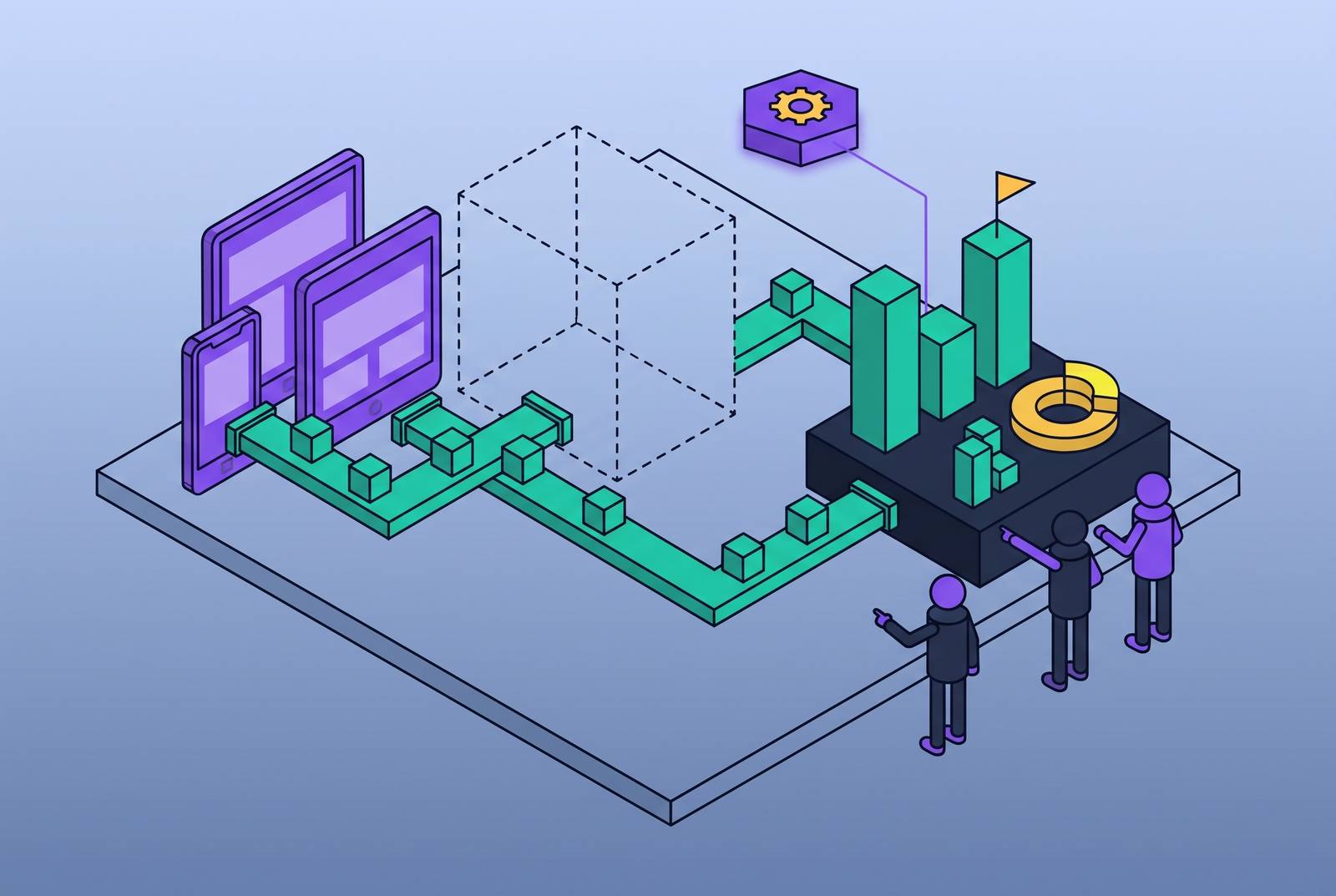
Operational analytics for product teams without a data warehouse requires a governed metrics layer. For API-first and agent-first teams building on Postgres, a headless analytics backend should expose pre-calculated metrics through an API without prescribing a frontend. This architecture gives people and agents consistent answers without a separate warehouse, an ETL stack, or a dedicated data team.
Why product teams on Postgres keep reaching for a warehouse they don't need
The assumption that analytics begins by moving data comes from enterprise data engineering. The conventional stack combines an ETL tool, a warehouse, and a BI tool because older BI tools could not read modern data sources directly. That workaround became a default architecture. Yet a team whose business records already live in Postgres may get no better answers by adding another place to store them.
A warehouse has a defensible role when billion-row analytical queries strain production or compliance mandates require a separated analytical copy. For most product teams under 200 people, neither condition applies. Their constraint is more immediate and less infrastructural. A question about revenue, activation, or retention still requires an engineer to interpret the schema and write a query, even though the underlying records are already available.
Someone must still define the metrics, decide how records relate, and control who can query them. Those responsibilities belong to a governed analytical layer, which a warehouse can support but does not itself provide.
What operational analytics actually means and what it doesn't
Operational analytics is how software organizes business data so that questions can be answered across systems with consistent definitions and traceable results. Without it, a question can require a manual export, a spreadsheet, and a guess. With it, the question runs against live records through an agreed model of what those records mean. The distinction is between possessing data and being able to use it.
A team can have a warehouse and still need manual work to reconcile records from different systems. Likewise, a dashboard shows fixed charts built from prepared data, but the analytical capability behind those charts can do more than they show. The dashboard is one consumer of that capability. Operational analytics lets people ask questions that the reports already built do not cover.
For a Postgres-native team, this means using the records it already has to build metrics it can trust close to the source. Revenue needs a definition that people agree on and use each time someone asks for it. Product usage needs the same discipline. Once those definitions are governed, different interfaces can answer questions from the same foundation without making a dashboard or a warehouse the mandatory starting point.
Why Postgres is a valid analytical home and where it genuinely struggles
Postgres can remain the analytical home for a product team, but that does not make unrestricted production queries a sound design. Supabase is built on a row-oriented database rather than one optimized for aggregating functions over column values. Heavy analytical reads put pressure on I/O as they compete with transactional reads and writes. They also expose connection limits under load.
Row-level security adds a distinct performance concern. RLS is evaluated for every row a query touches, and a naive policy can re-evaluate the authentication function once per row. Supabase documents wrapping the authentication call in a scalar subquery, (SELECT auth.uid()), so that Postgres can evaluate it once per query instead. An index on the policy’s filter column can make queries on large tables much faster. These are specific access and query-design problems.
The database also needs an observable baseline. Supabase has Logflare-powered logging across its services, a Metrics API that exposes Postgres performance and health metrics in a format that works with monitoring tools, and Index Advisor. These tools establish the prerequisite operational visibility for trusting an analytical layer above the database. The constructive response is to separate analytical requests from transactional work at the access layer, rather than assuming that every performance problem requires a warehouse.
The governed layer that closes the gap — pre-modeled metrics without ETL or schema changes
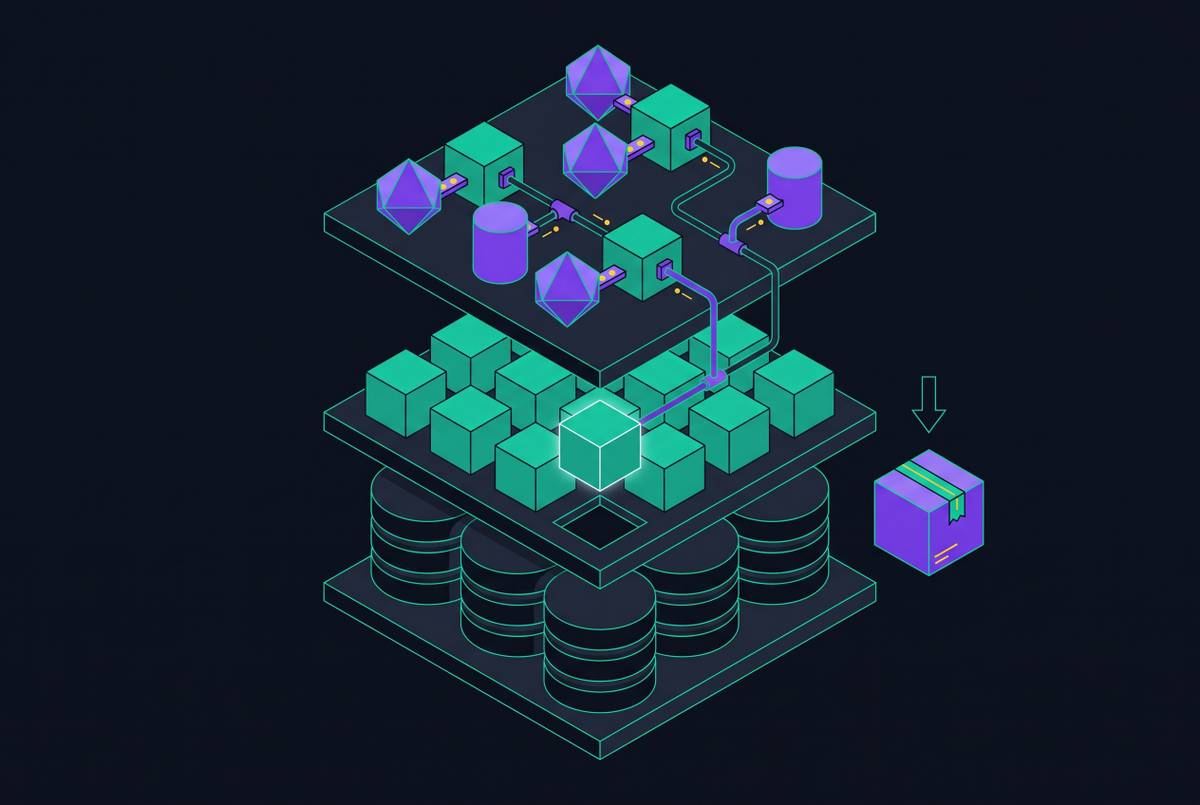
An independent, stateless analytical layer separates those workloads by answering questions from pre-calculated, governed datasets. It reads the existing Postgres schema and makes modeled results available through DuckDB queries against Parquet files. Production remains the source of business records. The analytical request path uses prepared results, so every dashboard refresh or agent question can be answered without going back through the transactional database.
Parquet is the unit of analytical access here. Its columnar structure makes the datasets economical to query with DuckDB, while portability keeps them independent of a prescribed frontend. More importantly, consumers receive a governed copy. That boundary separates the data needed to answer business questions from the raw database on which the application depends.
The promise of no ETL needs precision. This pattern does create derived Parquet datasets; it does not mean that no analytical copy exists anywhere. It avoids relocating the source database into a separate warehouse and maintaining the conventional extraction, warehouse, and BI pipeline. The existing schema remains the starting point, with no source schema changes or new infrastructure for the product team to manage.
Read-only source connections, defined relationships between records, and queryable results replace repeated interpretation of raw tables. This complements the existing Postgres database. It also makes the analytical layer stateless without pretending that the prepared datasets themselves do not exist.
Why metrics must be pre-calculated rather than queried on demand
Consider two engineers preparing reports for a board meeting. One writes SUM(revenue), while the other writes SUM(amount_captured). Both queries run successfully, yet the reports disagree about Q2 revenue. The discrepancy appears in the meeting because neither query is bound to a shared definition. Missing data is not the problem in this scenario. Independent metric logic is.
That disagreement is harder to settle when sales, finance, and product each keep their own calculations. Every metric on the CEO dashboard needs to reconcile to an agreed source, with ARR grounded in the billing system and product usage grounded in the analytics layer. Otherwise, the executive team must adjudicate definitions before it can use the numbers. Query correctness alone cannot settle that dispute.
Pre-calculation fixes this only when the definition is governed. Calculating two competing definitions ahead of time would make it faster to retrieve numbers that still disagree. The structural change is to model the metric once and make every consumer read the resulting dataset. A dashboard, a Slack report, and an AI agent then share the same analytical reference.
Agents amplify the cost of leaving that reference undefined. An agent generating SQL can produce an internally coherent calculation that diverges from the dashboard’s logic. Pre-modeled datasets remove the need for that invention. They make consistency a property of the access path.
How AI agents change the access requirements for a Postgres data layer
Supabase reports that, as of October 2026, a large majority of new databases on its platform are being created by agents or AI-driven tools. Agent-to-data access already needs to work at production scale, beyond what a future interface feature would need. A system designed around an engineer choosing when and how to query production does not provide the same protection when software makes those choices.
Direct agent queries can exhaust connection pools, and access that bypasses RLS can defeat the intended row-level boundaries. These risks are distinct from metric drift. An answer can use the right definition but come through an unsafe access path, just as a read-only query can give a misleading metric. Both the permissions and the meaning of the data need controls.
Those controls must be structural from the start. Read-only enforcement, access controls, and audit trails belong in the access layer before an agent is connected. Read-only access alone is insufficient. It restricts writes but does not, by itself, define which analytical records an agent may read or what a metric means.
The appropriate pattern places an MCP server in front of the governed copy. Agents such as Claude discover available datasets, understand their schema and meaning, and query the same pre-modeled metrics that dashboards use. Production credentials are not the analytical interface.
MCP as the access layer that makes a headless analytics backend practical
MCP replaces a web of agent-to-data integrations with a shared protocol. Before that common surface, each combination of agent framework and data source required its own connector. A governed backend could still exist, but exposing it to different agent clients demanded separate integration work. Standardization removes that particular obstacle. It does not remove the need to govern the data being exposed.
The July 28, 2026 MCP specification removed protocol-level sessions and the Mcp-Session-Id header from the Streamable HTTP transport. Any MCP request can therefore land on any server instance without the sticky routing or shared session stores previously required by protocol-level sessions. This supports a stateless access tier.
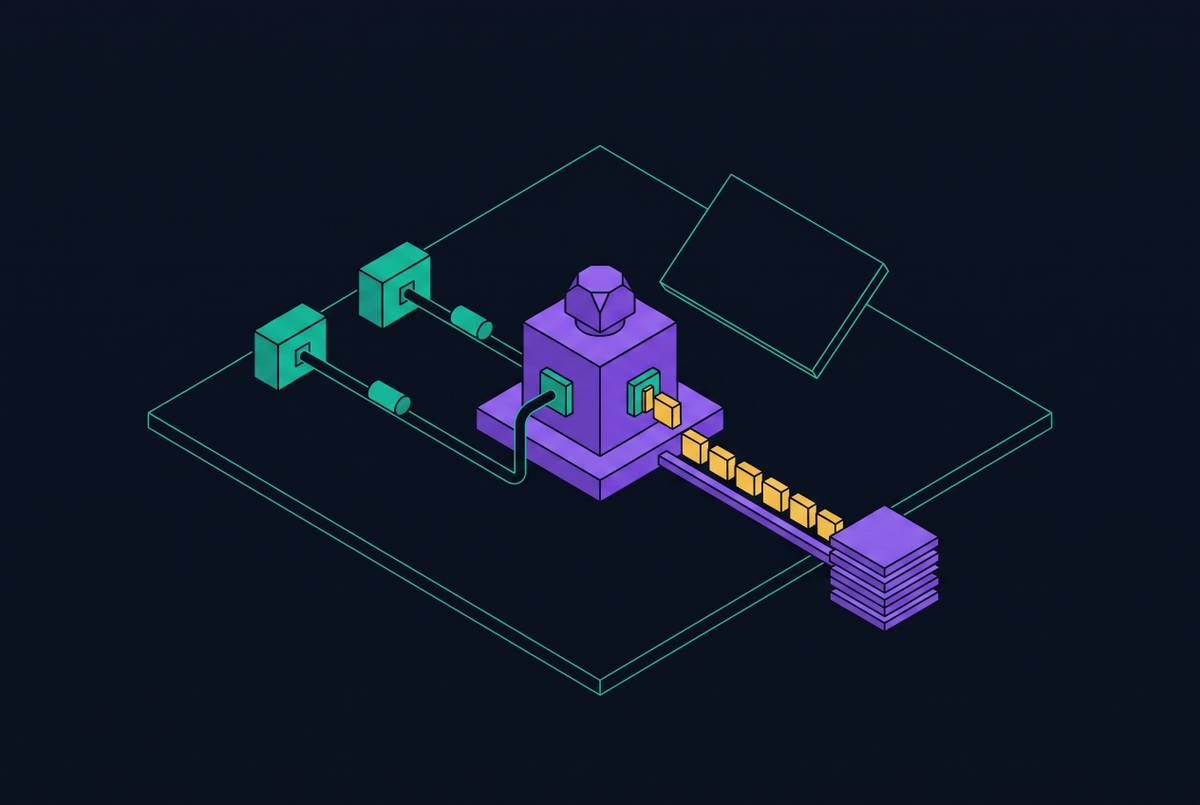
A headless MCP server exposes those metrics as tools through a background API, without requiring a chat interface or browser. Autonomous clients, scripts, webhooks, and cron jobs can orchestrate queries against that surface. For a Supabase team, the consumers can include an agent, a Slack bot, a dashboard, and a scheduled email report.
Security remains a separate obligation from interoperability. The U.S. National Security Agency warned in a May 2026 Cybersecurity Information Sheet that MCP adoption had outpaced appropriate security safeguards. That warning reinforces the architectural boundary. Read-only enforcement and access controls must be in place to protect the governed datasets before clients can reach them through MCP.
What does a Supabase team get on day one from a headless analytics backend?
Once the governed layer is in place, the founding team gets a canonical set of metrics, including revenue, activation, and retention. The CEO, product manager, and AI agent consume those definitions. A routine data question no longer needs to become a request for bespoke SQL.
For a team adding usage analytics to an AI agent without a prebuilt dashboard UI, the relevant interface is the MCP server. The agent receives analytical context from governed Parquet datasets, keeping its analytical queries out of the production Postgres connection pool and transactional query path. The team can build its own interface. A dashboard is optional because the backend’s definitions and access controls do not depend on one.
Supabase still needs to run well for the team to get this benefit. Logflare logging, the Metrics API, connection pooling, read replicas, and Index Advisor form the operational foundation described for this architecture. Workload separation does not excuse weak observability or poorly designed production access policies.
A founder or small engineering team can maintain the governed layer and add metric definitions without assembling separate ETL, warehouse, semantic-layer, and BI products. Definitions still require ownership, but routine consumption no longer requires repeated interpretation. For API-first and agent-first teams, the decisive selection criteria are governed metrics, production isolation, and programmatic access without an imposed frontend.