Agentic Data Sprawl and How It Breaks Startup Analytics
AI agents inherit fragmented data systems and amplify the damage.
A founder opens two dashboards built by two different AI agents, asks both the same question about last month's revenue, and gets two different numbers for the same time window. Neither agent is malfunctioning. Each is faithfully reporting what it found in the source it was pointed at, and that is the entire problem: agentic AI has moved from experimental demo to production workflow faster than startups have built any governance around what these agents are allowed to touch and trust. The gap between adoption and oversight is widest precisely where data infrastructure was never solid to begin with, which describes most early and growth-stage startups running lean technical teams.
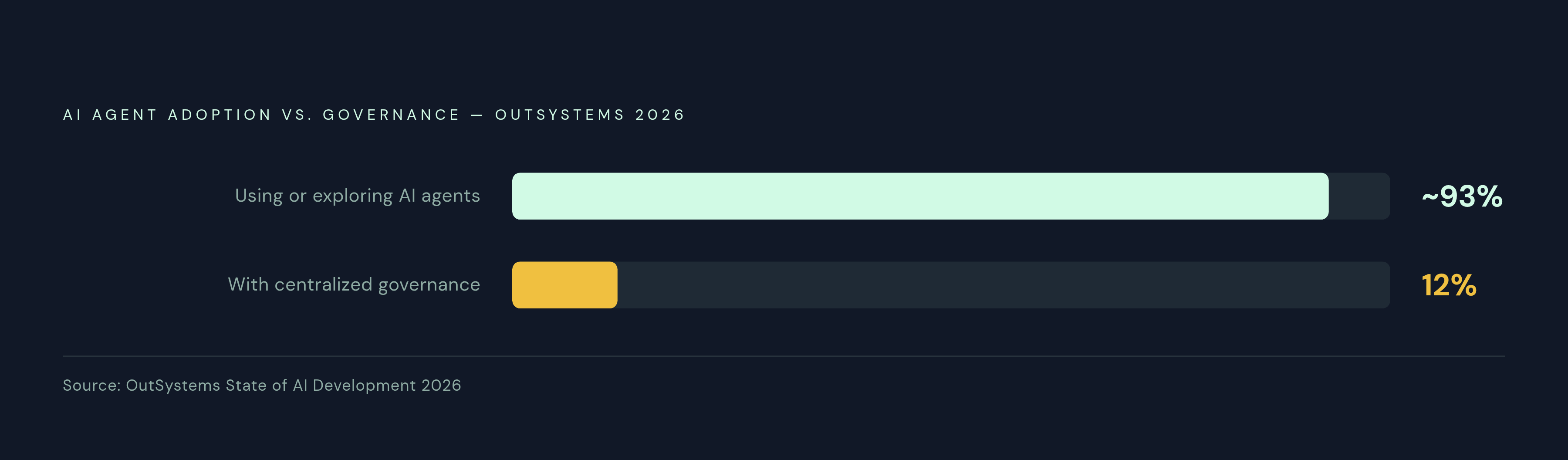
OutSystems' 2026 State of AI Development report found that nearly every organization surveyed is already using AI agents in some capacity, with almost all of them exploring agentic strategies that span entire systems. Only 12% of those same organizations have implemented a centralized platform to manage the sprawl that results. The same report found a large share of organizations mixing custom-built and pre-built agents, producing AI stacks that are difficult to standardize or secure. For a startup, metric definitions, table relationships, and the business logic behind a given number are scattered across documentation, dashboards, and the heads of a handful of early employees, before any agent even enters the picture. Agents don't fix that disorder. They inherit it instantly, and they do so without the hesitation a human analyst would feel before publishing a number nobody can explain.
How agents compound the fragmentation that was already there
Agents don't just operate inside fragmented systems. They multiply the fragmentation, because each agent queries its assigned source, reasons over whatever it finds, and returns an answer stated with total confidence regardless of whether that source was complete, current, or even the right one to ask. A broken dashboard tells you something is wrong. A confident, well-formatted answer from an agent tells you nothing is wrong, even when it is, and that difference is what makes agentic sprawl more dangerous than the dashboard sprawl that preceded it.
Most companies run several systems side by side that were never built to share data or coordinate state with one another. Agents operating across those systems run in isolation from each other even when they appear to be collaborating, each one building its own internal version of what's true. Only a minority of enterprise applications are genuinely connected in any reliable sense, so agents are constantly crossing boundaries between data sources without any awareness that a boundary exists. Forrester's The State Of Agentic AI, 2026 notes that long-running agents behave like distributed systems rather than chatbots, and that scaling such systems fails on task complexity, regardless of the number of agents deployed. Stitch together agents that don't share context, and the result is duplication and drift. By 2028, large enterprises are expected to be running far more AI agents than they run today, and most organizations still have no documented policy for creating or retiring an AI identity. Nobody is tracking which agent has access to which source or why.
The clearest version of the problem is simple: a sales-facing agent and a finance-facing agent both get asked for the same month's revenue number, and both answer immediately, and both answers are different, and both agents stated their number with identical confidence because neither one is aware the other exists.
What "agentic data sprawl" means for a startup's numbers
Agentic data sprawl describes the condition where multiple agents, each pulling from its own ungoverned source, produce metrics that cannot be reconciled with each other, and nobody at the company can say with confidence which number to act on. It is the mechanical result of the pattern described above, now expressed in the language a founder or a board member actually cares about: ARR, cash position, retention, usage.
The classic symptom looks like this: ARR comes from the billing system, cash comes from the bank feed, and product usage comes from a third source entirely, and when sales, finance, and a product-facing agent each maintain an independent version of the same metric, the executive team spends the meeting arguing about whose number is correct, delaying the decision about what to do about it. This is structurally the same problem startups have faced for years with competing spreadsheets, except agents remove the human checkpoint that used to catch the discrepancy before it reached anyone important: a spreadsheet does not publish itself to a board deck at two in the morning, but an autonomous reporting agent will. The vanity metric complaint that plagues so many startup board meetings is often a downstream symptom of this same sprawl. Many companies don't actually have a reporting problem. They have an interpretation problem and a prioritization problem misdiagnosed as a reporting problem, and agents, by generating more numbers faster, accelerate that misdiagnosis. Forrester's 2026 analysis names the cost of this directly as a "trust tax": every autonomous action an agent takes has to be logged and defensible after the fact, and that cost is already too high for enterprises with far more mature data infrastructure than most startups have ever built. OutSystems' research found that 94% of organizations are concerned AI sprawl is increasing complexity, technical debt, and security risk, a concern recorded before agents were widely generating and publishing analytics on their own.
The sprawl itself is not what breaks trust. A company can tolerate a large volume of metrics as long as they agree with each other. What breaks trust is contradiction: two numbers, both presented with equal confidence, both claiming to answer the same question, with no way for anyone in the room to adjudicate between them.
The Supabase-on-production pattern as a specific version of this risk
Supabase has become the default backend for a large share of technical startups, and for good reason: it provides Postgres, authentication, storage, realtime subscriptions, and serverless functions from day one, built on standard Postgres with real, enforceable security boundaries. That is a genuinely strong foundation for building a product quickly. It is not a foundation built for the kind of analytical load that agents now want to place on it.
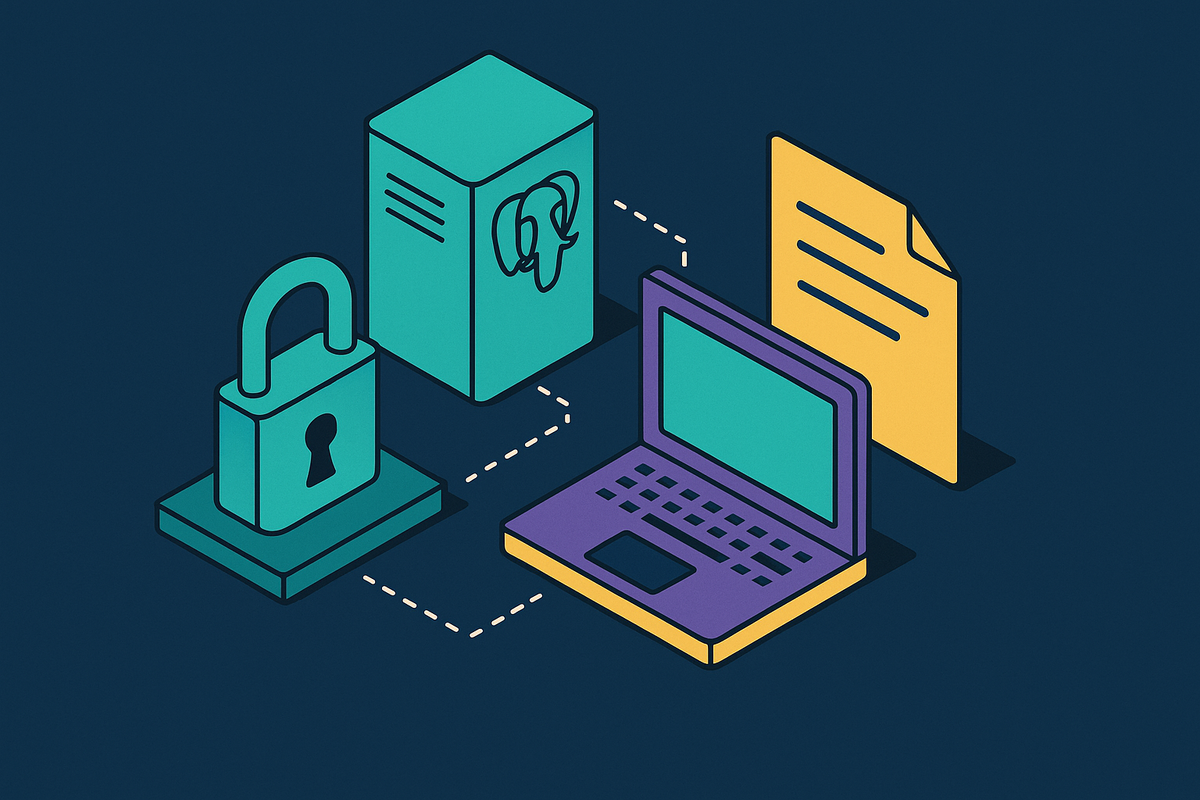
Pointing an AI agent directly at a production Postgres database, the way a team might point a BI tool at it, is the startup-specific expression of agentic data sprawl: the database underneath an app was built to serve transactions, not aggregations. Postgres will execute almost any query thrown at it, but pointing an agent at the same Postgres instance serving live application traffic means inheriting row-level security friction designed for app requests rather than analytical ones, hitting connection pooler limits meant for short transactional bursts, running aggregation queries against semi-structured columns that were never indexed for that purpose, and loading analytical work onto compute provisioned for OLTP traffic. The platform's own data-movement tooling exists precisely because the vendor recognizes this tension and gives teams a path to move data out of the transactional path before running heavy analytical work on it, which is itself an acknowledgment that production Postgres and analytics don't belong on the same compute.
Edge Functions add a second, more concrete failure mode. They enforce a request idle timeout and a per-request CPU budget, and calling an LLM synchronously past that window doesn't produce a slow response, it produces a 504 returned to the client. An agent hitting production Postgres through an Edge Function inherits both risks at once: the query risk of analytical load on transactional infrastructure, and the timeout risk of asking a request-scoped function to wait on a reasoning process it was never built to accommodate. None of this is hypothetical. Agents querying production without a governed layer in front of them can read data that row-level security was intended to restrict, trigger load spikes on infrastructure meant to serve paying users in real time, and return results that look complete and authoritative while actually reflecting the state of a table mid-write.
Why MCP doesn't solve governance
The Model Context Protocol standardizes how an agent calls a tool and retrieves a resource. It says nothing about whether the data that tool returns is correct, governed, or consistent with what another agent, using a different tool, would return for the same question. Treating MCP adoption as equivalent to data governance is the most common architectural mistake teams are making with agentic systems this year.
The July 28, 2026 MCP specification made real progress on the engineering side of the protocol: it made MCP stateless at the protocol layer, removing the initialize and session-handshake machinery entirely and enabling horizontal scaling across ordinary HTTP infrastructure. That is a meaningful milestone for anyone running MCP servers at scale. It changes how requests get routed and balanced across infrastructure. It does nothing to change whether the data behind those requests is accurate or consistent. The U.S. National Security Agency said as much in a May 2026 report on MCP, stating plainly that the protocol's rapid proliferation has outpaced the development of its own security model, meaning adoption is running well ahead of the governance thinking needed to support it safely.
The specific failure mode to watch for is what might be called semantic bypass: an agent connected through MCP calls a raw query tool instead of a pre-approved, governed metric tool, gets direct table access without any semantic context about what that table actually represents, and guesses at the rest. A wrong answer gets delivered with complete confidence through an interface that is, technically, standards-compliant. A well-designed analytics MCP server avoids this by exposing governed, intent-aware tools rather than raw database access, connecting semantic meaning and query access at the same layer. MCP is the transport. An agent still needs an identity, a governance policy, semantic grounding for the data it touches, acceptable query performance, lineage back to the source, cost controls, and an audit trail, and none of those arrive as part of the protocol itself. What matters is what that team's MCP server actually exposes, and whether what it exposes has been governed before the agent ever sees it.
What a governed data layer provides beyond MCP
The fix for agentic data sprawl is to pre-model data into a single governed layer that every agent and every human draws from identically, making contradictory numbers structurally impossible.
The right unit of analytics in a world full of agents is not a query but a modeled, pre-calculated dataset that both humans and agents can consume safely, and a raw query returns whatever a table happens to say at the exact moment it's run. A governed dataset returns what the business has already agreed a metric means, calculated once, in one place, and reused everywhere. One definition of ARR, maintained in one location and consumed by every agent and every dashboard that needs it, removes the contradiction problem by construction: no agent can report a different ARR, since every agent hits the same table. Governed datasets built this way should be queryable through DuckDB against pre-calculated Parquet files, which is fast, inexpensive to query, and fully decoupled from the production database that agents should never touch directly.
Agents should never touch production databases. A governed layer exposes only what has already been reviewed, modeled, and approved; row-level security is a real and useful boundary, but keeping agentic workloads off OLTP infrastructure is still necessary. The practical implementation of this principle is a single MCP server that exposes governed, pre-modeled datasets as its tools, so agents call functions that return certified metrics rather than functions that execute arbitrary SQL against live, transactional tables. This matters beyond the immediate reporting use case, because inconsistent metric definitions poison AI accuracy downstream in a more lasting way: if agents reason over or are trained on conflicting numbers, they learn the wrong patterns from the start and go on to produce conflicting insights long after the original discrepancy has been forgotten. Governance of this kind is both a human communication problem and an AI accuracy problem, and it compounds the longer it goes unaddressed.
The governance guardrails AI analyst agents specifically require
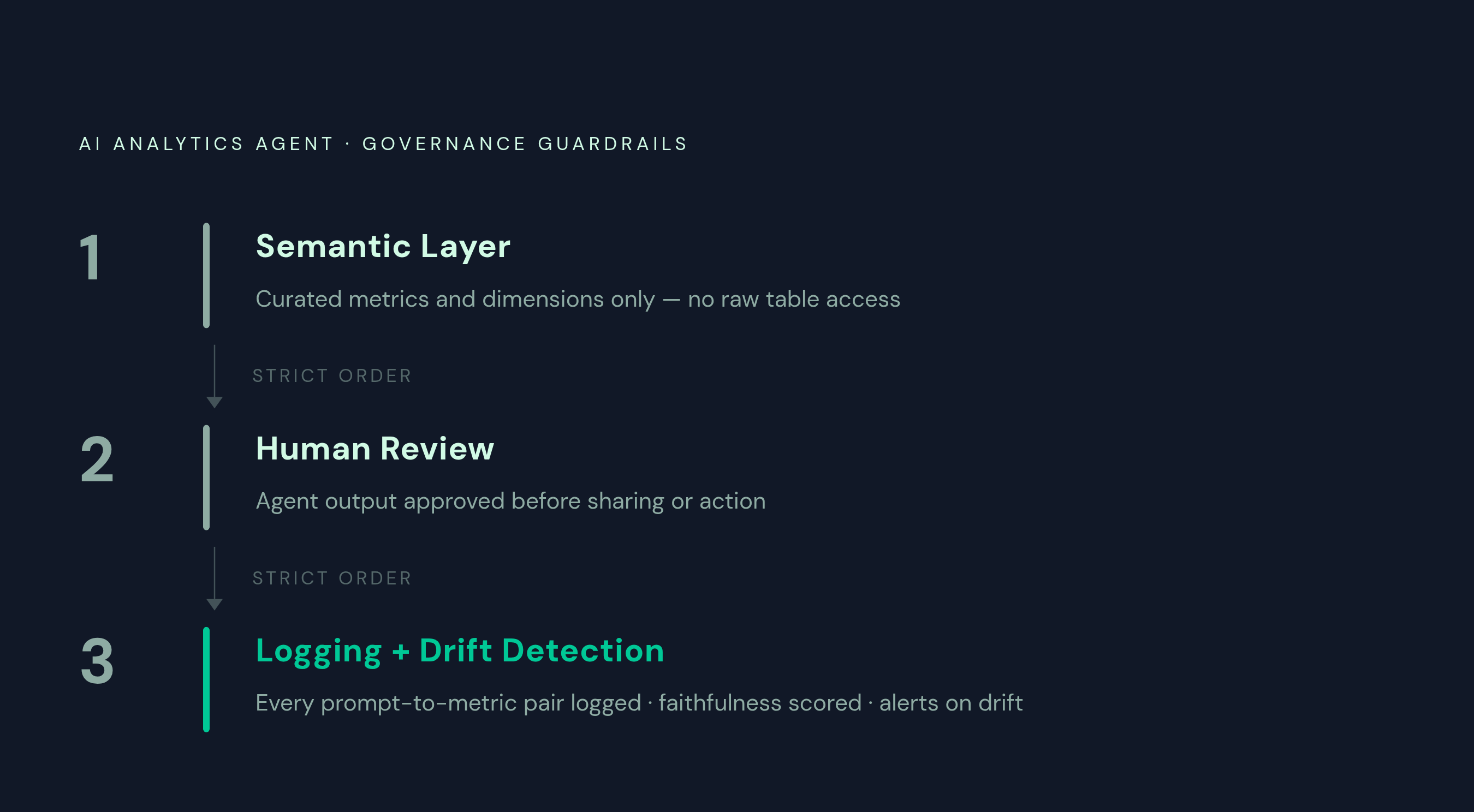
Three guardrails are non-negotiable for any AI agent running analytics workflows: a semantic layer the agent cannot bypass, human review of first-time outputs, and logged, evaluated records of every prompt that produces a result.
The semantic layer comes first. An agent's tool access has to be restricted to a curated, reviewed set of metrics and dimensions, and raw table access should never be offered to an analytics agent as an available tool, no matter how convenient it seems during development. Human review comes second. Any new dashboard or report an agent generates should require a human to approve it before it gets shared with a team or acted on by anyone, and an agent earns a wider scope of autonomy only once its output has been validated against that review process, not before. Logging and drift detection come third. Every prompt-to-SQL or prompt-to-metric pair an agent produces should be logged, a sampled slice of those results should be scored for faithfulness against the underlying governed data, and the system should alert when that faithfulness score starts to drift. An AI analytics tool deserves the same treatment as any other production LLM system: traces, evaluations, and a standing record of what it was asked and what it returned.
Together, these three guardrails don't just reduce the odds of a wrong number reaching a board deck. They remove the condition that makes agentic data sprawl possible in the first place, by ensuring that every agent, no matter how many are deployed or how independently they operate, is drawing from the same governed version of the truth.