Materialized Metric Snapshots as the Safe Handoff Point Between AI Agents and Supabase
Read-only snapshots seal production tables from agents and make immutability the safeguard.
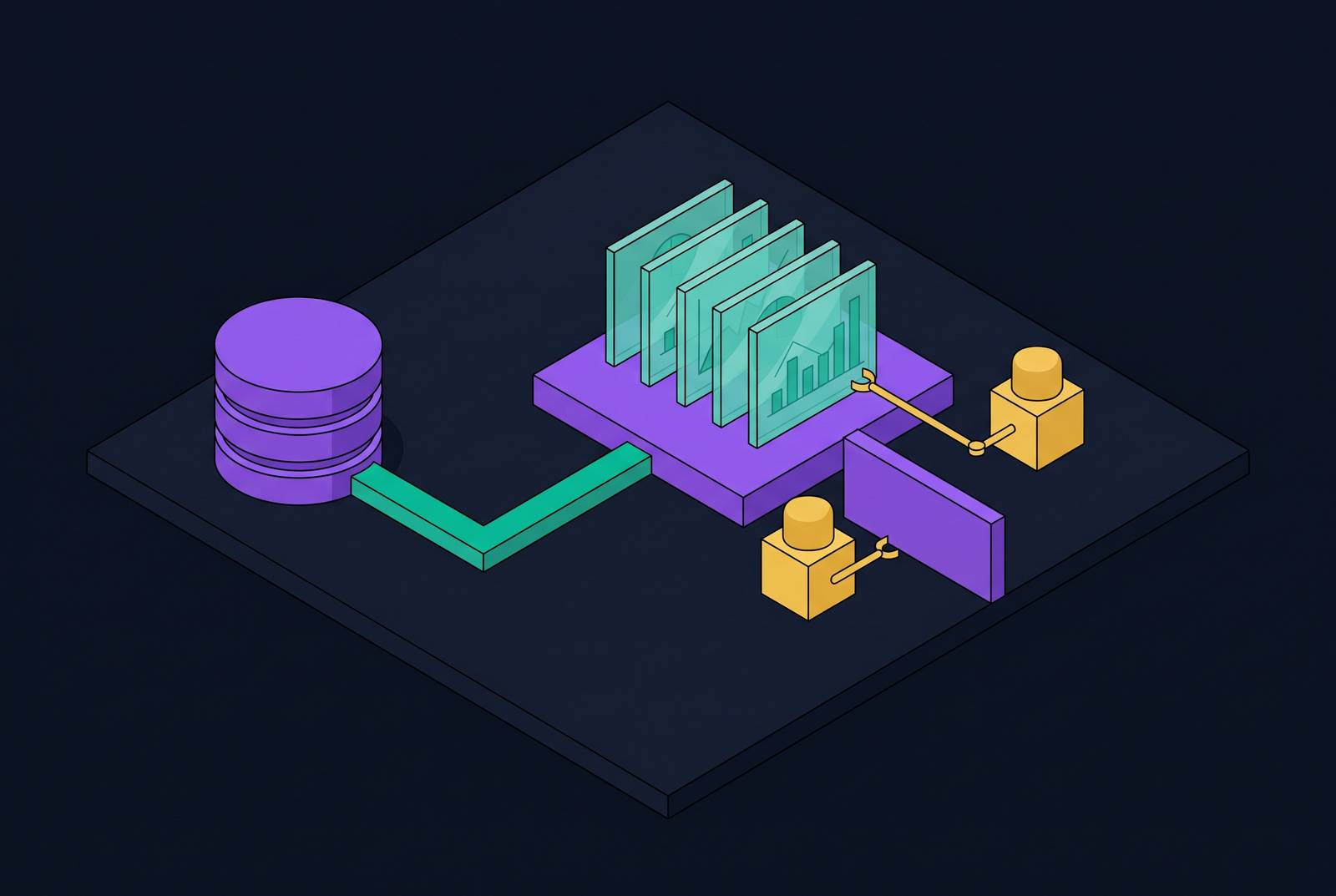
AI agents on Supabase should get governed data access through materialized metric snapshots that an access-controlled MCP layer exposes read-only, with base tables sealed from the agent. The snapshot supplies pre-calculated data that cannot mutate source state, while the delivery layer governs who can query it. This architecture makes immutability, rather than confidence in an agent’s behavior, the foundation of the handoff.
Why direct agent access to production Postgres is an authorization problem, not just an access-control problem
An agent with broad production access is “an over-eager intern with administrator credentials, operating at machine speed.” Its queries can follow instructions that no human has reviewed, including ones that came through prompt injection. A read-only role narrows that exposure substantially. But it does not settle whether a particular query should run, what the agent may do with its result, or how it may combine that result with later calls.
Uchi Uchibeke’s Before the Tool Call: Deterministic Pre-Action Authorization for Autonomous AI Agents examines how to authorize agent actions before they occur. Model alignment works through probabilities at training time, while post-hoc evaluation looks at actions after they happen. Neither enforces a deterministic, policy-based rule for each tool call. The paper reports that social engineering succeeded against an unprotected model the overwhelming majority of the time, while a restrictive pre-action policy reduced success to zero.
Five Eyes guidance published May 2026 places agents within existing cybersecurity frameworks under Zero Trust and least-privilege principles, rather than treating them as a separate safety category. Row-level security governs which rows a credential can see. It does not govern what an agent does with those rows, how it chains queries, or whether it pursues sensitive aggregates after being redirected. The architectural response is to reduce the data surface available to the agent before evaluating its requests.
What immutability actually means in Postgres and why it is the right property to build on
A Postgres materialized view stores a SELECT result separately from its source tables, with contents fixed between explicit refreshes. In core PostgreSQL, it stays as it is when those tables change. The pg_ivm extension can enable automatic incremental updates through triggers, but that is distinct from the explicit-refresh pattern. Here, immutability has a precise and limited meaning.
A live table changes as production writes arrive, while a materialized snapshot presents a stored result from a known computation. When the agent can query only a sanitized snapshot of aggregates, it has no route through that surface to modify source data. The base tables remain outside its reach. Physical separation refers to storage and can occur within the same database instance.
The same boundary limits what a manipulated agent can extract. If the exposed snapshot contains only computed metrics and excludes PII, an unexpected query cannot retrieve PII that exists solely in the sealed source tables. Sanitization is therefore a required step in making this safe. The OAP paper distinguishes containment from pre-action authorization, and snapshots belong on the containment side of that distinction. They remove source-data capabilities from the agent, but do not replace authorization for the capabilities that remain.
The freshness contract: what the snapshot promises and what it cannot
Every materialized snapshot is stale between refreshes. Changes to the base tables during that interval do not appear in the stored result, even when an agent asks for the latest answer. That trade-off is explicit. It is acceptable for many analytical workloads, but unsuitable for transactional reads where a user expects to see a change they just made.
KPI summaries, cohort metrics, and trend aggregations usually describe activity over a period rather than the state of a transaction at this instant. For these tasks, a known refresh window gives the answer an intelligible time boundary. A live query is fresher, but its result depends on the database state visible when it runs. Bounded, legible staleness can be the more useful contract. It lets a reader distinguish an old answer from an unexplained discrepancy.
Multiple snapshots introduce a second consistency question. A revenue total and a churn count that are refreshed on their own may describe different moments, even when both calculations are correct. Refresh ordering discipline addresses that risk, while explicit timestamps make differences visible. A snapshot is not automatically part of a synchronized set.
The practical rule is to embed a computed_at timestamp in every snapshot and include that provenance in the agent’s answer. Age then becomes part of the result. The timestamp makes the computation’s timing legible. Transactional agents that need real-time data need a different surface, because an analytics snapshot cannot stand in for current production state.
The Postgres mechanics that determine whether a snapshot refresh breaks production
The refresh mechanism can interrupt the very surface intended to provide safe access. A non-concurrent REFRESH acquires an ACCESS EXCLUSIVE lock on the materialized view and blocks reads until the rebuild completes. Agents querying continuously will encounter that interruption.
For a continuously queried view, concurrent refresh is the appropriate mode. It requires a unique index that lets Postgres match the new result against the existing view, compute the differences, and apply changes while reads continue. That availability has a compute cost. Concurrent refresh is not simply a faster spelling of the same operation, and its index requirement must be part of the implementation.
Disk capacity is the next constraint. A non-concurrent refresh writes a new copy before swapping it into place, so a large materialized view needs roughly double its size in free disk during refresh. Constrained Supabase plans make that requirement consequential. A snapshot can be inexpensive to query yet still expensive to rebuild, because read cost and refresh cost are different budgets.
A composite index on primary filter dimensions such as organization_id and created_at, combined with a suitable refresh strategy, can reduce dashboard query times by an order of magnitude. Those gains do not remove connection pressure. In the same Postgres instance, snapshot queries and refresh work still share database resources with production activity, so the pattern also depends on visibility into connections and query statistics. Separating stored data is not the same as isolating the workload.
How do AI agents query Supabase through MCP without access to production tables?
MCP provides the channel through which agents reach the governed snapshot surface. It is an open standard under the Agentic AI Foundation within the Linux Foundation, defining how agents discover sources, understand schema and meaning, and query in a structured way. The protocol is not the permission policy. A governed implementation adds identity, scoping, and audit so agents get data through one access-controlled interface instead of separate connectors that each have their own boundaries.
For the Supabase pattern described here, the Supabase MCP server is the starting option, configured for read-only exposure of the materialized metric views. The selection criteria are specific. The agent must be limited to the approved snapshots, base tables must remain inaccessible, and row-level access requirements must be enforced through the governed access design. Those conditions take more than a read-only connection. Production tables are outside the agent’s query path, even when the snapshots occupy the same Postgres instance.
Supabase Select 2026 added agent prompts that use a read-only connection to the server to check health, security, performance, and resources. Its query_logs tool provides structured access to logs across API, Auth, Storage, Edge Functions, and Postgres. These capabilities illustrate MCP’s operational role, but they are not themselves a metric-access policy.
Enterprise platforms show the same architectural direction. Salesforce Headless 360, announced at TrailblazerDX on April 15, 2026, exposed data and business logic through APIs and more than 60 new MCP tools. Informatica from Salesforce announced fully headless data management through governed services, with some integrations in Private Preview and general availability planned for Summer 2026. These are enterprise examples to assess individually for a Supabase team.
Why pre-calculating metrics into snapshots also solves the metric-drift problem for startup teams
The same restriction that keeps an agent away from production tables can keep a leadership team from debating incompatible numbers. Without a canonical calculation, one engineer writes SUM(revenue) while another writes SUM(amount_captured). Both outputs may be labeled Q2 revenue. The discrepancy becomes visible only when someone needs the figures to reconcile, potentially when an investor asks for audited numbers.
A semantic layer places the definition in one central location, and the materialized snapshot stores the result of that definition. The agent and the CEO dashboard then consume the same computation. When the calculation changes centrally, refreshed results propagate to the surfaces that query it. This prevents competing calculations within that governed path. It does not reconcile numbers from different refresh times.
For early-stage B2B SaaS teams, the recommended starting set is CAC, LTV, monthly churn, ARR, and gross margin. The aim is five or fewer actionable KPIs. A comprehensive warehouse is not required to stop disagreement over the handful of figures used to make decisions. Each dashboard metric should reconcile to its source, including ARR from billing, cash from the bank, and product usage from the analytics surface.
A data dictionary gives every metric a single owner, a single definition, and a single computation. The snapshot makes that dictionary operational. When sales, finance, and product query the same governed ARR result, they all use that version within that path. Agent safety and metric consistency therefore justify the same work for different reasons, with one limiting access and the other eliminating competing calculations.
What the governed snapshot layer looks like in practice for a Supabase team without a dedicated data function
A small Supabase team can begin with two or three materialized views and read-only MCP exposure, without establishing a separate warehouse or ETL system. The views live in the existing Postgres instance. This keeps the initial architecture small, although it also preserves the shared resource constraints described above.
A team taking this approach starts by finding the five KPIs that people keep disagreeing over. The first implementation can cover two or three of them, using one materialized view per metric with a computed_at column. Concurrent refresh runs on a schedule, supported by the required unique indexes. The server exposes those views read-only, while all base tables remain sealed from the agent. The central definition and the access boundary are established together.
Supabase’s Metrics API supplies Postgres signals in a monitoring-compatible format covering CPU, IO, WAL, connections, and query statistics. Its one-click Grafana Cloud integration, launched July 2026, provides a pre-built dashboard with alerting for every project, including free-plan projects. The team can use what it sees of database activity to manage refresh work, since a query that succeeds alone cannot prove that the whole system is healthy.
Heavier analytical workloads have another route. Supabase Pipelines, in public alpha on Pro, Team, and Enterprise plans, streams Postgres data to destinations including BigQuery, ClickHouse, DuckLake, and Snowflake, with schema changes detected and applied automatically. Keeping metrics in Postgres is the simpler starting point described here, while a separate analytical destination addresses a different workload need.
The interface may shift from a founder opening a dashboard to asking an agent in Slack, but the answer still needs a defined computation, a visible age, and an enforced access boundary. The governed snapshot supplies the first two, and the MCP access design supplies the third.