Context-Aware vs. Confident-but-Wrong AI Analytics Outputs
Grounding AI analytics in governed data is what stops fluent, confident errors.

It produced a confident, fluent, entirely false statement, and it did so with the same tone of authority it uses when it's right. That gap between confidence and accuracy is the central problem in AI analytics today, and it's worse there than almost anywhere else the technology touches.
An analytics output fails this way because of a structural difference in how it fails. A chatbot that fabricates a historical fact produces a sentence a reader can scrutinize, question, and often catch. Nothing about the presentation signals the error. The fluency and the formatting are precisely what make the failure invisible until a decision has already been built on top of it.
How the training objective creates the confidence-accuracy gap
The confidence-accuracy gap is an emergent property of how large language models are trained, and it persists across model generations without shrinking with each one. OpenAI's September 2025 paper on hallucinations lays out the mechanism directly: training and evaluation setups reward confident, plausible-sounding completions, not honest uncertainty. A model is never trained to say "I don't know," so when it doesn't know something, the statistically likely move is to generate an answer that sounds like it does.
Token-by-token generation works by picking the most probable next token given everything that came before it, and that probability comes from patterns in training data, not from any check against ground truth. Databricks has noted that this problem is trending in the wrong direction: newer reasoning models from OpenAI and DeepSeek hallucinate at higher rates than the models that preceded them, even as those newer models are marketed as more capable.
The compounding effect is what makes this dangerous in analytics specifically. An AI analytics agent rarely performs one step. It retrieves data, interprets what a given metric means, applies a filter, computes a comparison, and writes a narrative summary, five sequential steps where a small error in step one doesn't stay contained to step one. Step-by-step reasoning gets sold as an improvement, but the same feature makes errors compound. Attribution conflict produces a concrete version of this: when an agent sums conversions reported across multiple ad platforms without accounting for the fact that each platform claims credit for the same conversion, it returns a real, internally consistent number that means nothing.
Treating every AI output as a potential error
Governance bodies and enterprise risk researchers now treat hallucination as a baseline condition every AI deployment has to be built around, not as an occasional glitch. The September 2026 AGIL paper, drawing on the Stanford 2026 AI Index Report, documented a sharp rise in AI-related incidents in 2025, a signal of how quickly the failure surface is expanding as adoption scales across industries.
The financial stakes attached to this shift are substantial. IBM's 2026 Cost of a Data Breach Report found that global breach costs reached a record average of USD 4.99 million, with AI-related breaches running higher at USD 5.33 million on average. 68% of breached organizations had no AI governance policy in place at all, the finding that carries the most weight for governance purposes.
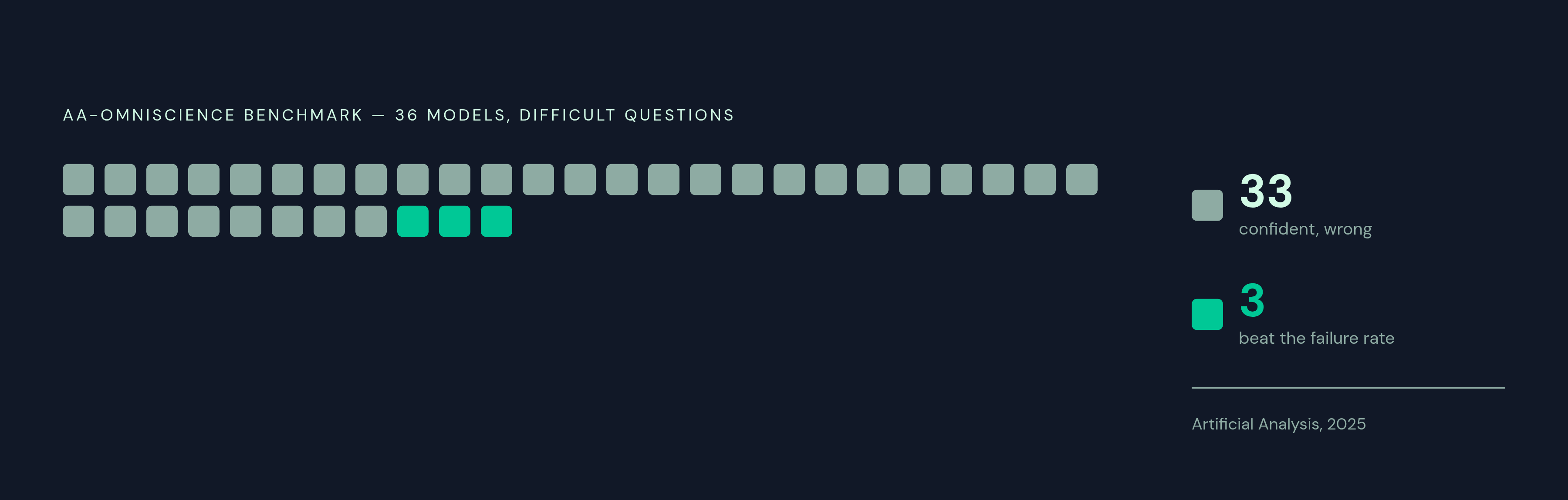
An analysis of Artificial Analysis's AA-Omniscience benchmark, a 2025 evaluation covering 36 AI models, found that all but three of those models were more likely to hand back a confident, incorrect answer than a correct one when the question was difficult. The implication for any organization deploying these systems is direct: every AI-generated response has to be treated as a potential vulnerability until something, a human reviewer or an automated check, has confirmed it. They define what organizations ought to do, but none of them provide runtime enforcement. The AGIL paper frames this as an architectural gap rather than an attitude problem: governance that depends on a human reading an alert and manually revoking access cannot act at the speed a machine operates at.
Why confident-but-wrong outputs do the most harm in analytics
Analytics carries the highest stakes of any domain where confident-but-wrong AI outputs appear, because analytics outputs get consumed directly as the basis for resource allocation, hiring plans, pricing decisions, and board-level reporting. Those are decisions that are expensive or impossible to unwind once they're made.
The specific failure modes in analytics don't have clean analogues in conversational AI. Cross-system entity mapping failures mean "customer" in a CRM, "account" in a billing system, and "user" in a product database may or may not describe the same entity, and an agent that doesn't know the mapping produces confident nonsense dressed up as insight.
None of this is hypothetical. Air Canada in 2024 showed you how a plausible-but-wrong AI output in a commercial context carries real legal and financial consequences, and that dispute arose from a single customer interaction, not a metric embedded in a board deck. The first person to see the number is the same person who acts on it.
What separates a context-aware output from a confident-but-wrong one
Whether an AI analytics output is reliable depends on whether the model is anchored to verified, pre-calculated data at the moment it generates a response. Two different models, given the same raw access to a production database, will both fill in gaps the same way: by drawing on training memory to invent a metric definition, assume a fiscal calendar, or construct an entity mapping that sounds reasonable but doesn't correspond to anything true about the organization asking the question.
Anthropic's research on what it calls concept vectors demonstrates that a model can be trained to recognize its own uncertainty and refuse to answer when it would otherwise guess. That's valuable, but it addresses the model layer, not the data layer. A model that knows to say "I'm not sure" is still wrong if the data behind it is raw, ungoverned, or was never properly defined, and Databricks points to retrieval-augmented generation, domain-specific fine-tuning, systematic evaluation, and data governance as the enterprise levers available to address hallucination, with grounding in governed data running through every one of them.
A context-aware output depends on three things no model can generate for itself. Metric definitions need to be pre-modeled: "revenue" gets defined once, certified, and served to the agent as an established fact. The datasets an agent queries need to be governed: validated, scoped to what's permitted, and shaped to match the organization's actual fiscal calendar and entity relationships. And access needs to be constrained: the agent sees only the data relevant to the question in front of it, not an open connection to raw tables where it's free to improvise joins and definitions that happen to look plausible. The quality of any natural-language analytics output depends on how well this semantic layer is built. Poorly defined metrics produce misleading results no matter how sophisticated the underlying model is, because organizational context lives in the semantic layer, not in the model, and without it, the model is guessing.
Building safe agent-to-data access on Postgres with Supabase
Teams building AI agent workflows on Supabase run into a specific version of the grounding gap described above: agents connected directly to a production Postgres database get raw, ungoverned access to that data, which creates risk on two fronts at once, analytical and operational. If you want to let an AI agent query Supabase data without handing it direct database access, you keep it off production Postgres entirely and route it through a governed interface instead, which is close to what Supabase itself recommends.
Supabase's own documentation on agent access is specific about where MCP connections belong. MCP access to Supabase is positioned for development and prototyping work, not for production databases under any circumstances. Supabase Evals, announced in July 2026, is an open-source benchmark built to test how AI coding agents perform against real Supabase tasks, including building schemas, debugging failed Edge Functions, and fixing broken row-level security policies. AI code output should be judged on whether it works safely against a real database, not on whether its explanation of what it did sounds convincing. That's the same standard that should apply to AI analytics output.
Practitioners building agent-to-data access on this kind of infrastructure have settled on three governance patterns. A compliance agent that ingests unmasked personal data from another agent's intermediate output can create a GDPR violation without either agent individually exceeding its access boundary.
A governed data layer between Postgres and AI agents as the structural fix
You can't fix confident-but-wrong AI analytics output with a better model or a more carefully worded prompt. It's a governed data layer that pre-calculates metrics, enforces consistent definitions, and exposes only verified datasets to agents at the moment they query. Organizations are responding to the governance pressure described earlier, so they're moving away from architectures where agents query production databases directly or improvise against raw tables. Instead, they're building a shared data layer, pre-modeled, access-controlled, queryable by human teams and agents alike, that treats a governed metric as the single source of truth and shrinks the space where hallucination can enter a business decision.
Pre-calculated metrics remove the largest single source of analytic hallucination, because the model no longer has to infer what "revenue" means, decide which tables to join, or guess at a fiscal calendar. Those decisions get made once, certified, and served as settled facts. This is the analytics equivalent of what retrieval-augmented generation does for factual grounding in language tasks: rather than asking a model to reconstruct knowledge from training memory, the system supplies verified context at the moment of the query. The retrieved object in analytics isn't a chunk of text, it's a pre-modeled, governed dataset shaped to the organization's own metric definitions and entity relationships.
Parquet datasets queried through DuckDB offer a specific architectural advantage here. They're fast and cheap to query, and they sit completely decoupled from the production database, so an agent querying a governed Parquet dataset never touches the live Postgres instance. That eliminates the analytical noise that comes from schema ambiguity and the operational risk of handing an agent write access to a production system. Exposing that governed layer through a single MCP server gives agents a structured interface: fast, accurate, cheap-to-query context without ever touching production, with the MCP server itself enforcing access scope and keeping an audit trail of every query made against it. The MCP server directly answers the lifecycle governance concern raised by Supabase's own guidance: instead of a broad database role that quietly accumulates permissions over months, it enforces a fixed, governed scope on every single call. One metric definition shared across every stakeholder and every agent does more for an organization's reliability than any dashboard feature could, because metric definition drift, the exact failure mode where "revenue" means something different depending on who's asking, gets eliminated at the data layer rather than managed after the fact at the prompt layer.
Dreambase is built around this pattern. It operates as a governed data layer on top of Supabase and Postgres, pre-modeling metrics into certified Parquet datasets and exposing them through a single MCP server, so that agents get the context they need without ever querying production directly. That's the kind of grounding that separates a reliable AI analytics output from a confident fabrication, and you get it without standing up a dedicated data team or a separate data warehouse.
Verifying that an AI analytics output is context-aware rather than improvised
Whether an AI analytics output can be trusted depends on whether the number can be traced back to a certified metric definition sitting inside a governed dataset, not on whether it looks correct. If it can't, the output is improvised, regardless of how confident or polished it looks.
Three checks make that distinction concrete. Source traceability asks whether the agent can show which dataset and which metric definition produced its answer; if it queried raw tables and assembled its own joins on the fly, the resulting number is unverified no matter how fluent the explanation sounds. Range plausibility checks an AI-generated metric against known baselines, prior period actuals, and manually verified spot checks, and it flags statistical outliers for human review before that number ever reaches a decision-maker.
Automated quality checks belong inside the pipeline itself, not tacked on afterward as a manual review step. The organizational habit that makes this kind of verification sustainable over time is a single, certified definition for each metric. When a semantic layer establishes a clear, certified definition for every core KPI, every report and every query draws from the same consistent source, and a human asking a question gets the same answer an agent would get asking it the same way.
For founders and small teams running without a dedicated data function, none of this requires hiring one. A governed data layer that pre-models metrics and exposes them through a safe, scoped interface builds the verification into the system itself. The output is trustworthy because it was grounded before the agent ever ran the query, not because someone happened to check it after the fact.