MCP as the Governed API Boundary Between AI Agents and Supabase
Agents get governed, named tools instead of raw Postgres access.
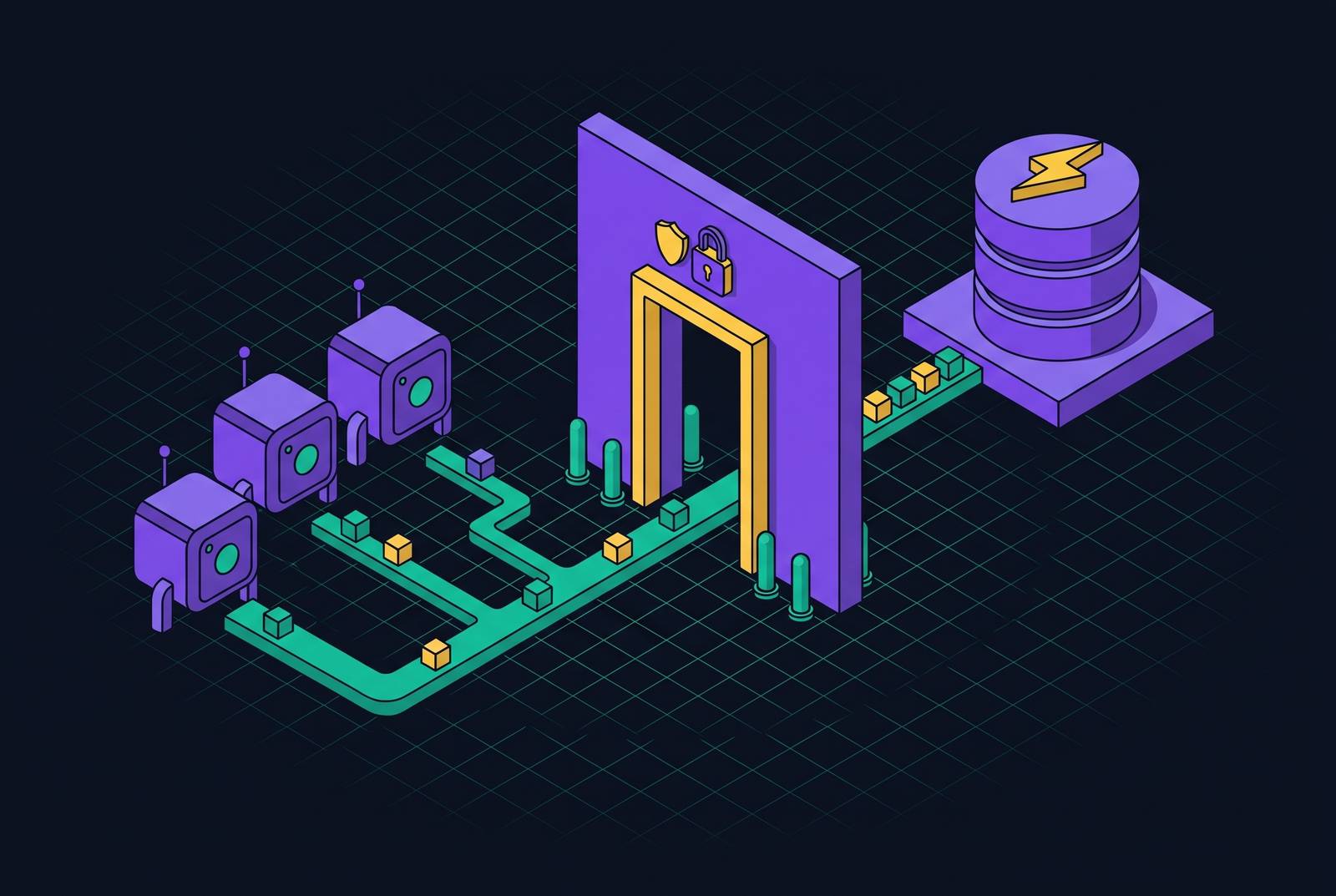
Governed data access for AI agents on Supabase requires an MCP boundary that enforces permissions and exposes approved data, rather than handing agents production database credentials. Supabase’s native MCP server supports infrastructure operations and user-scoped access, while analytics belongs behind a separate governed data layer. Named metric tools over pre-calculated datasets give agents accurate answers without a live query path into production Postgres.
Why MCP exists and what it standardizes
Before a shared protocol existed, each connection between an AI model and an external system required a bespoke integration. Adding models and tools multiplied that work. Anthropic released the Model Context Protocol as open source in November 2024 to standardize those connections. The Linux Foundation formed the Agentic AI Foundation in December 2025 with MCP as one of its founding projects, placing the protocol under neutral, open governance.
MCP defines a client-server architecture over JSON-RPC. Its three primitives are tools, resources and prompts. Tools are functions the model decides when and how to invoke, while resources provide readable data such as database records and API responses. Prompts supply reusable templates that shape how those capabilities reach the model. The July 28, 2026 revision made the core stateless and moved optional capabilities, including Tasks, interactive apps and enterprise-managed authorization, into a formal extensions framework.
What Supabase's MCP server actually exposes and controls
Supabase’s native MCP server exposes schema management, data operations, configuration, logs and Edge Functions as agent-callable tools. Its scope extends well beyond reading records. An agent with the right access can create tables, change row-level security policies, deploy Edge Functions and check logs without using the dashboard. The server therefore provides a programmable surface for platform administration as well as data access.
Supabase distinguishes infrastructure actions from actions performed for a signed-in user. For agent-initiated infrastructure changes, project API keys provide scoped permissions under the same role-based access control as a CLI user. Audit trails show which changes came from agents and which came from humans. In the user-initiated “headless app” pattern, an agent interacts through the app’s MCP server as the signed-in user. The server enforces that user’s row-level security policies, so the agent sees only the records the user is permitted to see.
Supabase also provides controls before consequential actions execute. Elicitations request human confirmation before an agent creates a paid project, creates a branch or runs SQL that could delete data. Project API keys have configurable rate limits that cap unbounded agent activity.
Why the MCP boundary exists and what breaks without it
Enabling MCP is not the same as governing it. A server with broad tools, write permissions and a production connection can expose much of the same authority as direct database credentials. The protocol standardizes access, but its configuration determines what that access permits. The architectural distinction is whether the intermediary enforces a bounded set of operations or simply forwards whatever SQL the agent constructs.
Without that enforcement, database content becomes an attack surface. Supabase describes how malicious text in a support ticket, comment field or contract clause can instruct an agent to run unintended queries or exfiltrate data. The risk arises when an agent both reads untrusted content and has the authority to act on it. A prompt that tells the model to behave safely still leaves it with that authority.
Sensitive records, including PII, PHI, financial information and credentials, can reach the model’s context without inspection at a governed boundary. Aggregations compete with user traffic for the same connection pool. SQL that the model writes can also define a business metric in a way that differs from the human team’s canonical calculation. Even with writes restricted, reads can expose data, use up capacity and give the wrong answer.
How the MCP boundary works as an enforcement mechanism, not just a connector
A governed MCP server makes enforcement part of execution. It controls the tools available, the scopes granted, the rate limits applied and the audit records written. Enforcement joins the agent’s requested action to the permissions and policies under which that action may proceed.
In the signed-in-user pattern, RLS supplies the underlying policy engine. The MCP layer preserves the user’s permissions rather than approximating them through instructions in a prompt. Separately identified agent audit records make behavior reconstructible for debugging and regulatory traceability. Pre-execution cost estimation and per-key rate limits also control resource use, putting a limit on the infrastructure charges an agent can run up while working on a task.
Data eligibility requires a further enforcement decision. ContextNest identifies the gap between retrieving relevant information and establishing its version, provenance and approval for AI consumption. A governed layer exposing pre-approved, versioned datasets addresses that gap before data enters the agent’s context. The stateless core also lets MCP server instances scale horizontally without session affinity while sharing policy and audit infrastructure.
Why analytics queries are the highest-risk category for agents hitting production Postgres
Analytics combines broad data access with expensive computation and definition-sensitive results. An aggregation can scan far more rows than a point lookup and hold locks while it computes. Its correctness depends on the metric’s meaning as well as successful SQL execution. This makes analytics a tough test of all three controls a production boundary needs: security, resource protection and semantic consistency.
A valid query can still answer the wrong question. When an agent writes aggregation SQL against raw Postgres, the metric definition lives inside that generated query. A dashboard, spreadsheet or teammate’s report may use a different definition of “what is our MRR this month.”
The appropriate agent-facing unit is therefore a pre-calculated, modeled dataset shared by human and agent consumers. A named analytical tool returns that modeled result without giving the agent the raw schema it would need to build a different definition. Claude and a dashboard can then answer from identical definitions. Pre-calculated datasets queried through an in-process engine such as DuckDB also avoid repeating live Postgres aggregations for each invocation. The aggregation cost is paid at materialization, although serving the resulting dataset still requires a read.
Active tool discovery and why the MCP boundary must be selective, not exhaustive
An exhaustive tool catalog is not a governance objective. Injecting every available schema into an agent’s system prompt consumes context and leaves the model selecting from capabilities it may not need. MCP-Zero shows how active, on-demand tool discovery works, with agents asking for tools as they work through a task. The paper reports a 98% reduction in token consumption on APIBank while maintaining high accuracy across multi-turn tasks.
That result supports selective discovery, but discovery is not authorization. Make the discoverable set itself curated and minimal so enforcement does not rely on the agent to ignore powerful tools. Named tools such as get_mrr_by_cohort and get_activation_rate_last_30d give agents approved analytical meanings in place of a generic SQL interface. Their descriptions help the agent choose the right calculation, while their narrow scope keeps it from exploring the raw schema. A capability absent from the permitted tool surface cannot be invoked through that surface.
What observability Supabase now provides and where the MCP boundary requires more
Supabase has materially expanded its native observability tools. OpenTelemetry integration supports export to compatible telemetry systems, while the Metrics API exposes Postgres metrics compatible with monitoring systems, covering CPU, IO, WAL, connections and query statistics. Unified Logs entered open beta on July 16, 2026. It brings API gateway, Postgres, Auth, Storage, PostgREST, Realtime and pooler logs into one searchable live view, with Log Drains supporting longer retention.
Those tools make infrastructure behavior visible and diagnosable. With distinct agent identifiers in the MCP audit trail, they help show which activity came from agents, which came from humans and how the agents used the database. Analytical observability asks a different set of questions. It must establish which metric the agent consumed, which dataset version supplied it and whether that definition was approved for AI use. A connection count or query statistic cannot supply that context.
ContextNest frames this distinction as a context governance gap. Knowing that a query ran is different from being able to reconstruct the approved information available to the agent at that point in time. A governed analytical layer with versioned, hash-verified datasets supplies the missing provenance. Agent responses can be traced to a specific dataset version rather than to an ad-hoc metric definition that existed only in model-generated SQL.
What the enterprise benchmark and the agent-to-agent future require from the boundary today
ZoomInfo’s GTM AI became generally available on June 1, 2026 as a headless, MCP-native context layer with no interface of its own. It grounds Claude, Codex for Work, Salesforce Agentforce, HubSpot Breeze and other surfaces in verified data. The significance is architectural rather than a requirement to adopt enterprise-scale complexity. Governed grounding is a distinct infrastructure layer that can serve whichever application displays the answer.
The same principle applies to smaller Supabase teams. When several interfaces consume a shared governed layer, permissions, definitions and provenance do not have to be reinvented for each interface. The enterprise example validates that separation of responsibilities without establishing a vendor ranking for Supabase deployments. The criteria for choosing a boundary are its tool scope, user-level access controls, dataset governance and how it keeps work separate from production workloads.
Agent-to-agent interactions make those criteria more consequential over time. Governance, audit logging and observability established at the start provide a basis for reasoning about a growing network of MCP calls. Retrofitting them after agents already depend on an ungoverned graph is materially harder.
How do you configure MCP so agents can query Supabase data without touching production?
The configuration should follow the separation of responsibilities. Supabase’s native MCP server fits infrastructure operations that require its platform tools, while an app’s MCP server can preserve signed-in-user RLS for user-scoped actions. Analytical access should use a governed MCP surface over pre-calculated datasets. These access paths serve different responsibilities, and an analytics agent’s tool access should reflect its analytical role.
For infrastructure access, give API keys only the permissions they need. A key used to read tables should not grant write access to them, and analytics should not require schema-write permission. For user-scoped access, use the database policy engine to enforce RLS through the MCP boundary instead of leaving that work to application logic or prompt instructions.
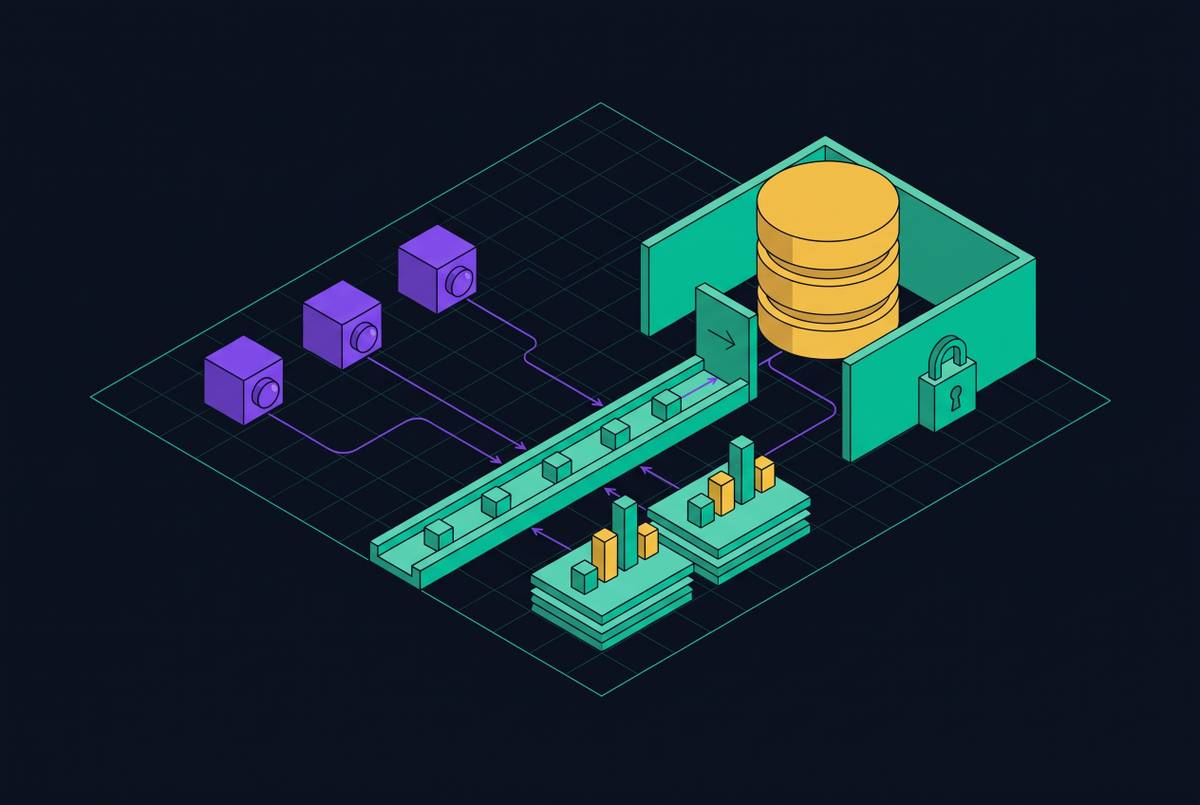
For analytics, give agents named metric tools in place of a generic query executor. A tool called get_activation_rate has a defined calculation, while execute_sql lets the caller decide what the calculation means. Serve those tools from pre-calculated datasets in governed Parquet, queryable through DuckDB behind the MCP server. This separates analytical reads from production writes and prevents agent invocations from consuming production Postgres connections or running live aggregations. Production data still has to be materialized, but that work is separate from each agent request.
That separation also bounds the consequences of prompt injection. Malicious text in a materialized dataset cannot trigger a live production query through an analytical tool that has no such path. It removes a specific authority that the injected instruction would otherwise try to exploit. With agents, dashboards and Slack notifications consuming the same governed metric, both access and the source of the answer are enforced by infrastructure.