Choosing an Analytics Backend for Teams That Need Raw API Control
A headless, governed layer gives agents and people the same trusted metrics.
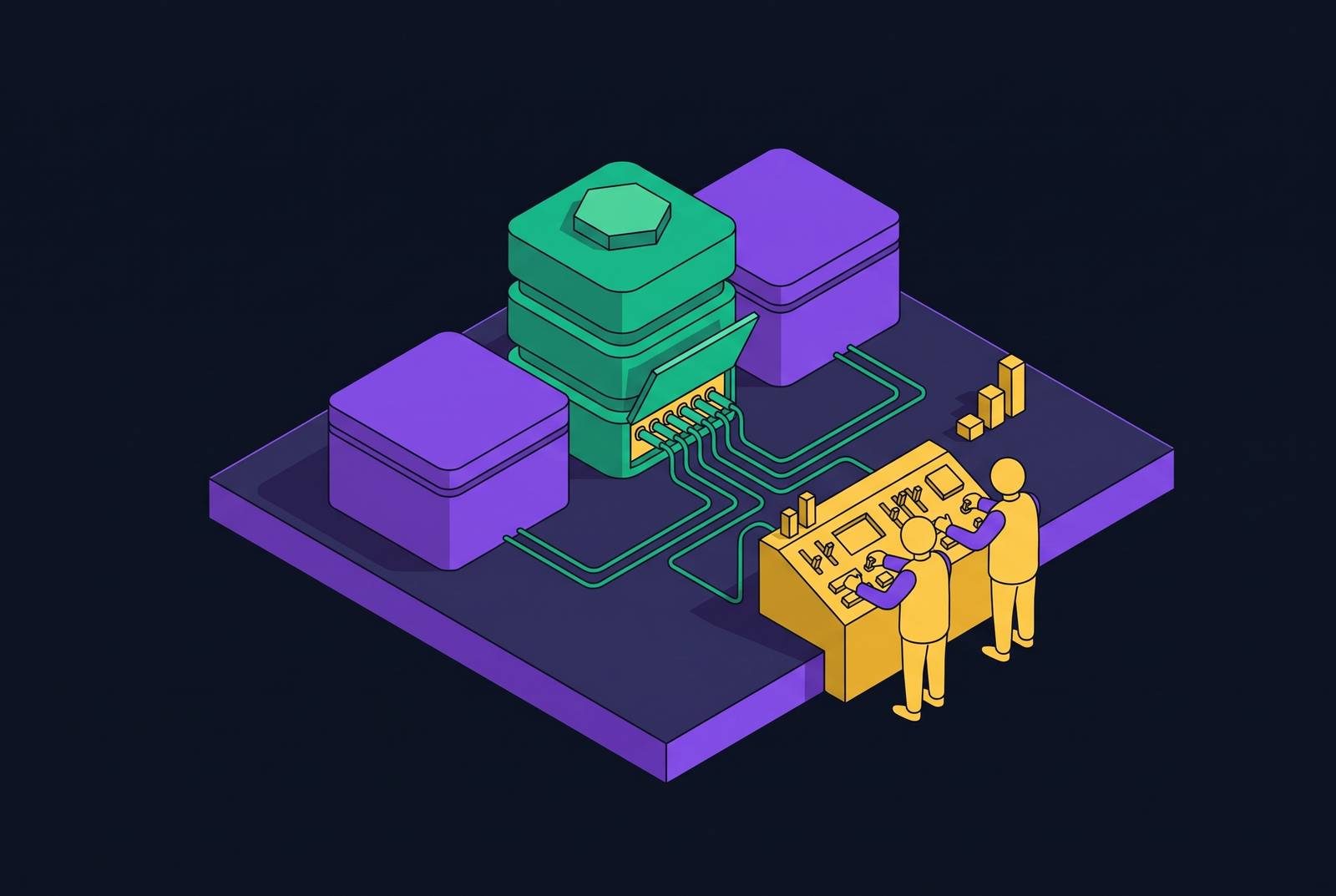
For teams that need raw API control without an opinionated frontend, the strongest analytics backend is a headless, governed layer that serves pre-modeled, pre-calculated data through APIs and MCP. Choosing that backend is an infrastructure-readiness decision. Human interfaces and AI agents need the same metric definitions, a clear account of freshness, and access rules that are enforced, without relying on a dashboard for context.
Why analytics backends are no longer just a developer-preference decision
Query language, SDK ergonomics, and cost-per-query once offered a reasonable basis for comparing analytics backends. That comparison assumed a human could compensate for what the interface omitted. An analyst could ask which revenue report was current, recognize an unreliable field, or wait a day for an export. Those fixes were rarely built into the architecture, which is the gap Dreambase, a headless analytics layer for Supabase teams that serves governed, pre-calculated metrics to people and AI agents through MCP or API, was built to close. Yet they gave people context that an autonomous consumer does not get.
Starburst says production-grade agents need secure access to live business data, a way to read data reliably across schemas, and the ability to act without approval at every step. An endpoint that accepts queries satisfies only part of that requirement. It does not tell the consumer which dataset is authoritative or whether a familiar column name has a different meaning elsewhere.
The consequence is more serious than an inconvenient developer experience. An agent can select a table and act without recognizing that its interpretation is uncertain. Promethium describes how missing governance-embedded business context allows agents to query inappropriate datasets, propagate errors downstream, and consume corrupted data without recognizing degradation. When those answers influence money, inventory, or customer experience, ambiguity becomes an operational risk. Backend selection therefore has to account for autonomous consumption before the first agent enters the workflow.
What agents actually require from a data backend that human engineers do not
Freshness is the first gap between ordinary analytics access and agent-ready infrastructure. lakeFS identifies data that reflects current reality, rather than an hours-old snapshot, as a distinguishing requirement for agentic access. A human may tolerate a stale dashboard because the delay is understood. An agent acting on financial positions may instead use information that is already out of date. More compute does not close that staleness gap.
Starburst says agents need table definitions, ownership, freshness, and access rules in the form of structured context before they reason. Human engineers can fill those gaps with their judgment and what they know about the business, including which fields nobody trusts. Agents have no such history to draw on automatically. As data keeps changing and agents gain access to new datasets, even column names that seem clear cannot be trusted to take the place of explicit definitions.
Governance must also match the speed and continuity of consumption. Promethium describes an agent provisioned with broad read access in January still using those permissions in August, after its business purpose has changed. Multi-agent workflows make the boundary harder to see. A compliance reporting agent can ingest unmasked PII from another agent’s intermediate output without either agent exceeding its stated permissions. Freshness, meaning, and authorized use are therefore structural requirements.
How MCP enables full API control without an opinionated frontend
MCP gives agents and data platforms a common way to connect, but the change to the architecture goes beyond adding another endpoint. Raw API control becomes the ability for human and machine consumers to reach governed, semantically consistent data through one access layer. Starburst distinguishes the protocol from the enforcement beneath it. MCP supplies connectivity, with governance provided by the enforcement beneath it. In a governed implementation, agents and dashboards use the same metric definitions rather than separately generating SQL that can invent competing definitions.
Informatica announced fully headless data management with native MCP support at Informatica World 2026 on May 20. Now a Salesforce subsidiary following the acquisition, the company described support across every major cloud and lakehouse platform, generally available on Microsoft Foundry and AWS Quick and in preview for AWS Agent Registry, Databricks, and Snowflake. MCP-compatible clients can invoke its data management operations without custom integration code. ZoomInfo’s GTM AI became generally available June 1, 2026 as a headless, MCP-native context layer without an interface of its own. Its use case is different, grounding surfaces including Claude, Salesforce Agentforce, and HubSpot Breeze in verified company and contact data.
For analytics, the useful unit is a pre-modeled, pre-calculated dataset available through MCP or API, decoupled from any single frontend. That separation resembles what headless CMS did for content. However, when an MCP feature is limited to premium tiers or particular deployment modes, those limits restrict who can use the governed layer and how they can reach it. The implementation and its availability determine how much control the protocol actually provides.
The access patterns that actually keep agents from touching what they shouldn't
An agent with read-only access can still expose PII, select the wrong version of a metric, or pass an incorrect result into a chain of downstream decisions. Governance must constrain what comes back from a query as well as whether the query can run. Controls limited to the application cannot provide that boundary when analytical access bypasses the application.
lakeFS recommends a verifiable identity for every agent, with permissions scoped to its task. Promethium recommends separate API keys and database credentials for support and financial reporting agents, even within one organization. Separation makes attribution and scope limitation possible. Permissions also need explicit retirement when an agent is decommissioned or repurposed.
Runtime enforcement supplies the next boundary. Promethium says every action should be checked at the request level instead of relying on policies checked only when a session starts. Attribute-based access control extends beyond static roles, while row-level security limits returned records and column-level masking redacts sensitive fields. A fraud detection agent can then see transaction amounts without getting payment card numbers.
Analytical agents should not have production database credentials embedded in their configuration. Their queries should reach a governed layer that logs access and enforces permissions, with pre-calculated datasets queryable through DuckDB over Parquet providing an access point away from production. Reproducibility needs its own preparation. lakeFS identifies lineage and version control as necessary for tracing decisions back to their inputs. InfiniSynapse recommends testable security SLOs covering export, denial, and replay before production keys are granted.
Why Supabase teams face this problem earlier than they expect
Supabase’s API-first design makes it a natural starting point for startups, but transactional and analytical workloads have distinct requirements even with convenient access. Supabase’s documentation recommends read replicas for complex analytical queries and reserving the primary for user-facing operations. Analytical work placed on a primary sized for transactions competes with the application it serves. RLS friction and pooler limits further complicate that arrangement.
Supabase documents a particularly consequential RLS performance trap around auth.uid(). Without a scalar subquery wrapper, Postgres re-evaluates the function for every row scanned. Although auth.uid() is STABLE, the planner does not hoist it into an init plan without (SELECT auth.uid()). That distinction can separate a millisecond response from a timeout on large tables.
Other documented early failure modes include connection limits, bad indexing, chatty queries, and misuse of realtime subscriptions. They do not wait for a large organization. An agent querying production Postgres for analytics amplifies them because its request frequency and volume exceed those of a human dashboard user. The same API convenience that accelerates application development makes it easy to introduce analytical load before its effects are visible.
The practical response starts with observability from day one. Supabase’s native Metrics API exposes Postgres performance and health metrics in Prometheus exposition format, while p50/p95 latency dashboards make query behavior visible. Enabling pg_stat_statements and auto_explain is the minimum viable starting point. A quarterly review of top queries captures most of the value at almost no infrastructure cost. These practices expose workload problems early, while a separate governed analytics layer keeps agent consumption from becoming another source of production contention.
What a governed analytics layer does for metrics that a query interface cannot
Separating analytical workloads protects application performance, but it does not by itself make the resulting numbers trustworthy. Sales, finance, and product can still maintain different versions of ARR, active customer, or CAC on perfectly responsive infrastructure. The disagreement comes from missing governance over what the numbers mean. A query interface gives access to data without deciding which definition the executive team should use.
Metric ownership is the organizational counterpart to that technical boundary. One person needs to own the definitions and serve as the final arbiter of what CAC means. Otherwise, drift returns within weeks of a tooling change. A semantic layer records that agreement as a shared business dictionary. The infrastructure can then expose a named, pre-calculated metric instead of requiring every consumer to reconstruct it.
Pre-modeled metrics can be pushed to inboxes, Slack, and phones rather than pulled only when someone remembers to check. An agent consuming the same governed dataset as a dashboard receives the same numbers without independently assembling a definition. Freshness remains a separate requirement, so pre-calculation must not be mistaken for permission to serve an unsuitable snapshot.
For early-stage B2B SaaS teams, the recommended discipline is five to seven actionable KPIs rather than a growing catalog of loosely defined measures. The core set includes CAC, LTV or the LTV-to-CAC ratio, monthly churn, MRR/ARR, NRR, and gross margin. More metrics just add noise until those have stable definitions. This narrower scope also makes ownership and shared definitions more tractable. Teams still need a way to get that governed layer before the business can support a dedicated data team.
How early teams get governed analytics infrastructure without building a data team
A hybrid model pairs in-house metric ownership with outsourced or partnered analytics execution. It gives a growth-stage team a way to establish governed data without a six-figure data leadership hire or a multi-year infrastructure project. Ownership stays with the business. Execution can come from outside it, provided the engagement produces shared definitions rather than a collection of reports understood only by their author.
The available models include staff augmentation, managed analytics teams, fractional consulting, hybrid arrangements, and project-based outsourcing. The choice affects speed and cost more than the vendor brand does. At pre-seed, with no internal analytics function, a managed analytics team or a single project-based engagement is the starting point. For growth-stage teams, the hybrid model preserves internal authority over metrics while using external execution. These models change how teams work as well as how they buy analyst hours.
Durability depends on what remains after the engagement. A semantic layer leaves a shared dictionary in which revenue, active customer, and CAC have the same meaning everywhere. Without it, definitions remain in the contractor’s head and drift when the engagement ends. Applied to the Supabase stack, the managed analytics team pattern targets infrastructure without ETL, schema changes, new infrastructure to manage, or a wait to hire a data engineer.
The MCP server makes this arrangement headless. Agents, dashboards, and reporting surfaces consume the same pre-calculated, governed metrics, so adding agent usage analytics does not require a prebuilt dashboard UI or a separate definition pipeline. Teams that choose only for developer preference face re-architecture when the first agent reaches production. Teams that choose for infrastructure readiness can build on the governed layer already in place.